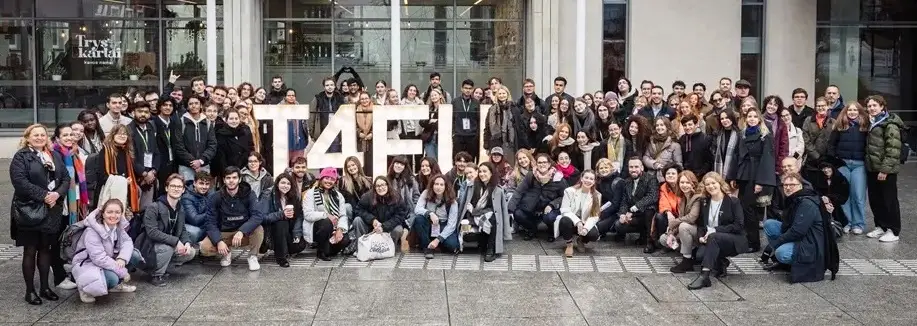

T4EU Focal Points 2025
Hello, T4EU Family!
As we approached the end of 2025, it is time to pause and look back at a year that has truly redefined who we are. For us, this isn’t just a seasonal summary. It is a celebration of a major milestone in our shared journey.
Our vision of building one university has moved from a concept to a reality. Whether you are a student exploring our joint educational offer, a doctoral candidate collaborating across borders, or a staff member participating in our professional development programs, you are the heartbeat of this single, integrated institution.
- PROF-SYNERGY Conference
- Hosted by Vytaustas Magnus University (Lithuania)
Being a part of one university
Sven Idarand, T4EU Secretary General
Photo by Małgorzata Dymowska
Take a while to read how the T4EU General Secretary Sven Idarand would sum up 2024 in three words and what he said about the most interesting threads in 2025.
- I am really happy to speak to you on this joyous occasion as our Transform4Europe Alliance celebrates its 5th anniversary. It's a great moment to look back at what we have achieved together over the past years, the many events we have organised, the strategies and reports we have developed, and the people and institutions we have connected across Europe. Seeing the full scope of this work is truly impressive and I would like to sincerely congratulate everyone who has been involved in building the Alliance. Nonetheless, five years in the life of a university alliance is still a relatively short period, and what we have created so far is nothing more but a starting point and a strong foundation for the future. Coming back from our recent Strategic Assembly, I was especially encouraged by the energy, motivation, and enthusiasm of our teams and by the clear willingness to take the Alliance further. Looking towards 2035 and beyond, I am sure that we will continue to expand and Transform4Europe into a truly strong and inspiring European university. Congratulations to all of you, all of us, and thank you for being part of this journey.
Samule’s journey
In the meantime, check the journey of Matteo Commellato, a Master’s student in Environmental and Nature Sciences and Technologies at the University of Trieste, who shares how the T4EU has profoundly shaped his academic and personal growth.
Five years together
2025 also marks a 5th anniversary of our Alliance. We have transitioned from a project into a permanent partnership. This year saw the official establishment of our Legal Entity, a step that solidifies our future. Furthermore, the launch of the Joint Grants Office is already empowering scientists to reach new heights in international funding and innovation.
- An important step in solidifying our cooperation is the establishment of the T4EU Joint Grants Office. This international project office, funded from own resources of the Alliance members, supports researchers in acquiring funds for research projects. This will further strengthen our scientific ties.
- We are testing various forms of cooperation – joint study programmes, diplomas, short-term mobility, educational paths, and research projects – with the aim of making them a permanent part of the offer at each of our universities. The institutionalisation of our cooperation is a key tool to achieve this goal.
- T4EU Strategic Assembly and Policy Conference
- Hosted by Vytaustas Magnus University (Lithuania)
Roadmap
The official ceremony to mark the establishment of the Alliance as a legal entity was held during the T4EU Strategic Policy Conference at Vytautas Magnus University in Kaunas. The document was signed by the rectors of the T4EU partner universities.
The efforts to establish the legal entity were coordinated by a team led by Prof. Tomasz Pietrzykowski, Vice-Rector for International and Domestic Cooperation at the University of Silesia in Katowice. The signing of the document constitutes an important stage in the development of the Alliance, proving its sustainability and readiness to act independently on the international stage. This marks a step beyond the project framework — the T4EU Alliance is now evolving into a lasting and structured partnership.
01. Management, Governance and Joint Infrastructure
Vytautas Magnus University hosted the “Universities Shaping the Future” Policy Conference, featuring keynote addresses by former Finnish President Sauli Niinistö and Lithuanian President Gitanas Nausėda.
For our students and staff, this high-level dialogue reinforces the university’s role as a critical stabilizer in modern democracy. By engaging with global leaders to solve complex crises, we demonstrate that our university is providing our community with the skills and security needed to live in an uncertain world.
01. Management, Governance and Joint Infrastructure
Handover of the T4EU Presidency
Following its 2024–2025 term, Vytautas Magnus University has officially handed over the T4EU rotating presidency to Sofia University “St. Kliment Ohridski.” This transition is a key part of our joint governance structure, ensuring that leadership is shared across our partner institutions.
The T4EU Presidency of Sofia University will focus on strengthening the scientific capacity of the T4EU University and promote the responsible application of artificial intelligence with a human dimension.
01. Management, Governance and Joint Infrastructure
In 2025 we participated in the EAIE 2025 Conference in Gothenburg, Sweden, Europe’s largest international higher education event. As one of 35 European University Alliances present, the T4EU delegation showcased its collaborative vision for the future of higher education.
Explore ‘T4EU Voices in Higher Education,’ a curated collection of reflections from our delegates on the future of global academic cooperation.
01. Management, Governance and Joint Infrastructure
“An important step in solidifying our cooperation is the establishment of the T4EU Joint Grants Office. This international project office, funded from the own resources of the Alliance members, supports researchers in acquiring funds for research projects. This will further strengthen our scientific ties.
~ Prof. Dominik Brodowski, Vice-President for Internationalisation and European Relations at Saarland University, T4EU Steering Committee member
01. Management, Governance and Joint Infrastructure
Joint Policy for Incoming and Outgoing Students
Transform4Europe introduced a shared framework to streamline student and staff mobility across the Alliance. We created a joint policy with a clear timeline for planning, organising, and reporting mobilities, along with a standard information template for event hosts. The result? Better coordination, smoother participant selection, earlier travel planning, fewer last-minute costs, and clearer communication between all partners.
Students and staff had the opportunity to participate in mobility activities within the Transform4Europe Alliance. By providing clear procedures, standardised templates, and coordinated timelines, participants experienced smoother planning, reduced last-minute costs, and better access to support and resources during their exchanges.
02. Mobility4All
Network of Buddies
A network of student mentors (buddies) was created to welcome, support, and guide visiting students from the Transform4Europe Alliance throughout their exchange. Each participating university selects student ambassadors who lead small groups of visiting students, supporting their transition, adaptation, and integration into university life. Depending on each partner’s capacity, the network may also provide additional support to T4EU staff.
T4EU visiting students receive personalised guidance and support during their exchange programmes, whereas student ambassadors gain valuable leadership and mentoring skills, and T4EU staff may benefit from the additional support provided by the buddy network.
02. Mobility4All
Welcome Days
Organised for incoming students, Welcome Days provide orientation, guidance, and support. These events help students integrate into university life, connect with peers, and become familiar with campus resources and the academic environment.
Incoming students benefit from practical guidance, access to key resources, and opportunities to build social connections, enabling them to begin their university experience well-prepared.
02. Mobility4All
Info Sessions
A total of 23 Info Sessions were organised for students interested in mobility programmes, introducing the Transform4Europe (T4EU) alliance and its opportunities. Overall, 3,138 students attended the sessions, contributing to increased awareness and understanding of T4EU mobility opportunities among prospective participants.
The primary beneficiaries were students interested in mobility programmes, who received clear information about the T4EU alliance and the opportunities available to them. University staff promoting T4EU also benefited by engaging effectively with a large student audience.
02. Mobility4All
Seamless mobility within T4EU allows students to study at a partner university at the same level and in the same field – without extra tuition fees and without administrative complexity.
Thanks to pre-approved study programmes negotiated by T4EU partners, students no longer need to independently match courses with their home curriculum.
With four seamless mobility agreements already signed between T4EU universities, studying abroad becomes easier, faster and more accessible. For our students, it means less bureaucracy, more certainty and a truly smooth international learning experience.
03. Transforming Curricula
Vertical mobility opens new pathways for students who wish to continue their studies at the next level abroad. Within the Alliance, facilitated vertical mobility agreements ensure automatic academic recognition of completed undergraduate studies, eliminating barriers typical of traditional admissions processes.
With three agreements already signed and two more in preparation, T4EU is expanding access to high-quality Master’s programmes across Europe. For students, this means clear progression, international opportunities and confidence that their academic achievements are fully recognised.
03. Transforming Curricula
T4EU joint Master’s programmes are collaboratively designed by several partner universities and include mandatory mobility periods. Upon graduation, students receive a degree from each participating institution – two or more – reflecting a truly European education. These programmes combine academic excellence, interdisciplinary perspectives and international experience within a single study path.
With nine joint programmes already running and eight more under negotiation, T4EU is actively shaping innovative, future-oriented education. For students, this means stronger qualifications, international diplomas and a competitive advantage on the global job market.
03. Transforming Curricula
Microcredentials are short, focused learning modules lasting less than one semester and offering academic credits. They can stand alone – such as summer schools or professional courses – or be integrated into degree programmes from undergraduate to doctoral level. By combining microcredentials across disciplines, learners can build personalised learning pathways and acquire skills that are immediately applicable in professional contexts.
With 150 microcredentials offered, T4EU empowers students to learn flexibly and strategically. For our learners, it means customised education, practical skills and greater control over their academic and professional development.
03. Transforming Curricula
T4EU Matchmaking Events bring academic staff together in person to spark new collaborations in research and education. Each partner university hosts one event, with a total of ten events planned by 2027.
These meetings create space for exchange, networking and the development of joint projects and joint study programmes. For academic staff, it means new partnerships and projects – and for students, it translates into innovative joint programmes and enriched learning opportunities.
04. Academy for Professional Excellence
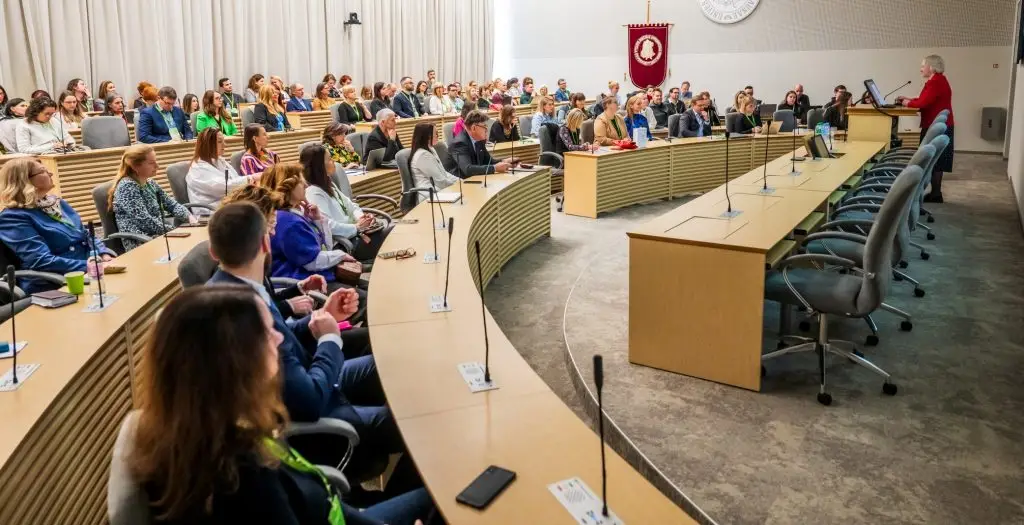
PROF-SYNERGY, or ‘Enhancing Professional Excellence: Synergy of Academic and Non-Academic Staff’ is a conference that brought together representatives from all T4EU universities to strengthen staff development and institutional cooperation. Participants exchanged best practices in professional training, digitalisation, sustainability and inclusiveness, emphasising the importance of continuous competence development across all staff groups.
With 157 participants, 3 keynote lectures and 28 professional growth sessions, the conference reinforced a holistic approach to professional development. For our academic and non-academic staff, it means stronger collaboration, shared standards of excellence and a common institutional culture across the Alliance.
05. Academy for Professional Excellence
The first Transform4Europe Innovative Teaching Prize recognised outstanding teaching practices across the Alliance, highlighting educators who push boundaries and redefine learning experiences. 45 applications were submitted, reflecting a wide range of innovative approaches aligned with T4EU’s strategic priorities.
With four prizes of EUR 2,500 awarded to the most innovative teachers, T4EU placed teaching excellence at the heart of its mission. For our academic staff, it means recognition, visibility and strong encouragement to continue innovating in education.
05. Academy for Professional Excellence
T4EU launched its first-ever Non-Academic Staff Prize Competition, celebrating the vital role of support staff in shaping modern universities. Applications across four categories showcased impactful solutions in areas such as digitalisation, sustainability, inclusiveness, staff development and management.
With 34 applications and three monetary prizes awarded, T4EU highlighted the creativity and leadership of non-academic staff. It means recognising all staff as agents of change and strengthening a truly inclusive, collaborative institutional ecosystem.
05. Academy for Professional Excellence
The summer school strengthened the inclusion of vulnerable researchers within the European research community. Over five intensive days, more than 30 participants from 18 universities and organisations engaged in expert-led sessions covering teamwork, communication, critical thinking, mental health, international collaboration and European research funding, supported by valuable contributions from UNHCR and EURAXESS.
Bringing together participants from over 10 countries, the programme created a learning environment that not only developed professional competences, but also offered space for connection and long-term collaboration – reflecting T4EU’s commitment to inclusiveness, solidarity and academic freedom.
05. Academy for Professional Excellence
The manual is a practical guide designed to help students navigate university life. Developed in close collaboration with experts and students, it supports mindful, informed, and confident decision-making throughout everyday campus life. Grounded in research and enriched with real-life examples, the manual addresses topics ranging from studying smarter and AI in learning, through mental health, anxiety and addiction risks, to sexuality, sustainability, career orientation, and access to professional support.
Rather than offering rigid rules, the manual encourages exploration and adaptation. It introduces the concept of the knowledge entrepreneur – empowering students to take small, conscious steps toward balance, resilience, and purpose in daily life.
06. Green Campus, Life Inclusion and Wellbeing
The handbook translates sustainability from abstract goals into everyday campus practices. Addressed to both students and staff, it offers clear and actionable guidance for reducing environmental impact at individual and institutional levels. Structured around key themes such as sustainable mobility, energy efficiency, digital sustainability, biodiversity, green procurement, and food practices, the handbook showcases real-life examples from across T4EU universities — proving that meaningful change often starts with simple choices.
Beyond practical tips, the handbook emphasises collective commitment. With tools, templates, and inspiration, it invites entire academic communities to grow greener together. For T4EU, it is not just a guide – it is a shared step toward a more sustainable future for universities.
06. Green Campus, Life Inclusion and Wellbeing
Diversity and inclusion are at the core of T4EU’s vision for an integrated European university. To support this commitment, the Alliance developed a comprehensive repository of good practices, policies, and resources from all partner universities, offering a clear overview of what already exists and how it can be used in daily academic life. The repository is complemented by awareness-raising activities, including inclusion workshops organised during T4EU weeks.
By combining structured resources with lived experiences and dialogue, T4EU turns strategy into practice. For students and staff, this translates into stronger support and a university environment where inclusion is actively built – not just declared.
06. Green Campus, Life Inclusion and Wellbeing
In September, the T4EU community was invited to participate in a shared challenge: reaching one million steps before Christmas. Open to students, staff and the wider public, the initiative ran for 100 days. Using the StepUp app, participants tracked their progress together, supported by motivational tips and shared encouragement. What started as a health initiative quickly became a community experience and a conversation starter during T4EU Week.
With around 400 participants actively involved, the challenge strengthened both physical and mental well-being – and a sense of belonging. It showed how simple ideas can bring people together across campuses and borders.
06. Green Campus, Life Inclusion and Wellbeing
Talking openly. Caring collectively
Throughout the month, a carefully designed sequence of online activities encouraged reflection on everyday mental well-being. It began on World Suicide Prevention Day with five practical steps on how to talk to someone in distress, offering clear guidance for difficult but crucial conversations. Daily positive reminders and accessible tips shared via social media reached a wide audience. The initiative concluded on World Mental Health Day with a collective reel of students and staff sharing personal ways of caring for their mental health.
All content was prepared and supervised by experts in psychology and suicidology, ensuring responsible and safe communication. The month helped students and staff normalise conversations about mental health and reinforced the message that support, awareness, and care belong at the heart of university life.
06. Green Campus, Life Inclusion and Wellbeing
Shared heritage across borders
Students, staff, and experts explored European heritage through the lens of borders, shared histories and cultural encounters. The programme of the event combined an online lecture, multidisciplinary conference panels and workshops in anthropology, history, architecture and literature, along with field visits in Trieste and Gorizia that translated theory into real-world heritage challenges.
By bringing together 50 participants from across the Alliance and beyond, the week created a space for dialogue between academia, students and local stakeholders. It strengthened shared academic practices and a common understanding of heritage as a living, cross-border process.
07. Common Heritage and Multilingualism
The first festival explored how tourism can simplify – or reshape – complex urban histories. Using Trieste as a living classroom, students examined the city as tourists, while critically reflecting on which narratives are highlighted and which remain invisible.
Through guided visits, workshops, group work, a film screening and discussions with scholars and stakeholders, participants engaged with the role of borders in shaping European identities. The festival supported T4EU’s vision of one university by turning joint learning into a common European experience.
07. Common Heritage and Multilingualism
The first T4EU Sustainable Heritage Student Competition brought together students from across the Alliance to rethink how cultural heritage responds to climate change. The competition combined lectures, workshops, and collaborative group work, encouraging students to design cultural projects rooted in local contexts yet relevant across Europe. Citizen science, intergenerational memory, and sustainable strategies played a central role.
By connecting academic learning with GLAM+ stakeholders, the initiative bridged theory and practice. It offered students hands-on experience and reinforced a shared, alliance-wide approach to sustainable heritage.
07. Common Heritage and Multilingualism
The catalogue brings together all language-learning opportunities available across the Alliance in one accessible digital space. It allows students to easily explore and compare courses offered by partner universities, supporting mobility and multilingual learning. Closely linked to the T4EU Multilingual Campus Strategy, the catalogue reflects a broader ambition: fostering linguistic diversity, intercultural competence, and inclusive communication across borders.
Beyond the tool itself, the process created lasting collaboration among language teachers from all partner universities. By building shared resources and professional networks, the catalogue laid a common foundation for a truly European university campus.
07. Common Heritage and Multilingualism
It is a dynamic digital platform showcasing cultural and heritage initiatives developed across the Alliance. As a searchable database, it highlights collaborations between universities and GLAM+ sectors – including galleries, libraries, archives and museums – making visible community-driven projects, innovative themes and inter-sectoral partnerships.
The portfolio provides an overview of transformative cultural work within T4EU. For all actors in the Alliance, it serves both as a knowledge base and a source of inspiration for future cooperation and societal impact.
07. Common Heritage and Multilingualism
In 2025, T4EU took a decisive step beyond Europe. The strategy was operationalised through the signing of the first global cooperation agreements with partner universities in Australia, Georgia, and Mozambique. These agreements are more than formal partnerships – each is supported by a joint roadmap for 2025–2027, setting concrete directions for teaching, research, mobility, and civic engagement.
By aligning all partners around a shared global vision, T4EU strengthened its capacity to act internationally. This positions T4EU as a reliable and engaged partner worldwide.
08. Outreach
The second annual round of the T4EU Science Communication Course expanded training opportunities across the Alliance, equipping participants with practical skills to communicate research beyond academic circles. Delivered through a coordinated series of workshops, the course reached students, doctoral candidates, early-career researchers and academic staff.
With 246 participants trained, the initiative strengthened a shared approach to public engagement. It also laid the groundwork for future Alliance-wide formats, including the planned Science Communication microcredential.
08. Outreach
The first T4EU Sustainable Heritage Student Competition brought together students from across the Alliance to rethink how cultural heritage responds to climate change. The competition combined lectures, workshops, and collaborative group work, encouraging students to design cultural projects rooted in local contexts yet relevant across Europe. Citizen science, intergenerational memory, and sustainable strategies played a central role.
By connecting academic learning with GLAM+ stakeholders, the initiative bridged theory and practice. It offered students hands-on experience and reinforced a shared, alliance-wide approach to sustainable heritage.
08. Outreach
The catalogue brings together all language-learning opportunities available across the Alliance in one accessible digital space. It allows students to easily explore and compare courses offered by partner universities, supporting mobility and multilingual learning. Closely linked to the T4EU Multilingual Campus Strategy, the catalogue reflects a broader ambition: fostering linguistic diversity, intercultural competence, and inclusive communication across borders.
Beyond the tool itself, the process created lasting collaboration among language teachers from all partner universities. By building shared resources and professional networks, the catalogue laid a common foundation for a truly European university campus.
07. Common Heritage and Multilingualism
It is a dynamic digital platform showcasing cultural and heritage initiatives developed across the Alliance. As a searchable database, it highlights collaborations between universities and GLAM+ sectors – including galleries, libraries, archives and museums – making visible community-driven projects, innovative themes and inter-sectoral partnerships.
The portfolio provides an overview of transformative cultural work within T4EU. For all actors in the Alliance, it serves both as a knowledge base and a source of inspiration for future cooperation and societal impact.
07. Common Heritage and Multilingualism
Here you can check out our roadmap of initiatives and tasks we completed in 2024, our 2025 goals, and some current numbers.