

Cooperation without data sharing. New challenges for AI
The rapid development of artificial intelligence presents researchers with many new digital challenges. One of these is the issue of distributed data, protected by individual institutions. An example of such data might be the test results of patients suffering from the same condition, collected across many different hospitals. If gathered together and analysed, they would be an excellent source of knowledge for doctors, who could then diagnose and treat patients more quickly. PhD student Katarzyna Kusztal is working on a solution to this problem under the supervision of Małgorzata Przybyła-Kasperek, PhD, DSc, Assoc. Prof. (USil Faculty of Science and Technology), in cooperation with Prof. José García-Rodríguez (University of Alicante, Spain).
‘I am working on the classification of distributed data. Put very simply, this refers to a situation where the data we’re interested in comes from various sources. So I’m investigating how we can utilise knowledge obtained locally and then combine it so that accurate decisions can be made without having to treat all the data as a single set’, says Katarzyna Kusztal from the Doctoral School at the University of Silesia.
A good example is medical data collected in different hospitals. Let’s imagine patients who, as part of their diagnosis, undergo the same set of laboratory tests. Although their results end up in very similar tables, the procedure for carrying out the tests can be completely different. This is because laboratory medicine, both in Poland and across Europe, is not standardised. Hospitals use different technologies and equipment. Testing for a heart attack marker is a prime example. Even if two patients from different hospitals receive an identical numerical result, its interpretation may differ depending on the analyser used and the associated reference ranges. ‘I’m interested in how you can search for similar data from many such sources and how to combine them to gain a broader perspective, while not losing sight of the significant differences that a doctor would easily spot,’ adds the PhD student.
In medicine, this challenge is particularly difficult due to the need to protect sensitive data. As this data is scattered across hospitals, clinics and laboratories, it cannot simply be merged into a single database. That would be too risky. This is precisely why the algorithm currently being developed is such a promising solution.
Such a model could, for example, help doctors diagnose unusual cases more quickly and select personalised treatment by comparing a patient’s profile with thousands of similar case histories. What’s more, it might even enable the early detection of epidemics by identifying recurring symptoms across different hospitals.
‘It is worth noting that the solution we are developing is versatile and will also prove useful in many other sectors, such as finance. Financial data relating to the same range of services is of particular interest. The automatic identification, classification and analysis of credit histories from different banks would significantly speed up the work of analysts, for instance when making decisions on granting loans’, says Katarzyna Kusztal.
Prof. Małgorzata Przybyła-Kasperek, meanwhile, highlights the importance of data security. ‘At this stage of the research, we do not plan to either collect or share any actual sensitive data. We are developing a machine learning method which we can subsequently commercialise. We therefore use only data from publicly available repositories. In the future, once we reach the implementation stage, data security will be handled by experts specialising in it’.
Data analysis involves searching for similar structures and forming coalitions from them. This enables the model to learn patterns that are not only consistent but also cover a much broader scope, and are therefore more accurate.
Prof. Małgorzata Przybyła-Kasperek emphasises that these are so-called interpretable models. This means that their internal logic and decision-making process should be comprehensible to humans. Consequently, if a doctor receives an answer to a question of interest, they will also be able to assess the decision-making pathway. This approach enables errors to be spotted more quickly, which is of enormous importance in any sector, not just medicine or finance. This machine learning algorithm is therefore safer and sufficient for analysing tabular data, although it will not be suitable for more complex tasks such as image processing.
This solution may be of interest to all owners of distributed digital data, namely those collecting sales data, information on parcel locations, network traffic operators, academic consortia, public administration bodies, and even insurance companies.
‘We have already developed some methods for classifying distributed data, but we have several more in the pipeline’, emphasises Katarzyna Kusztal.
The research is being conducted in cooperation with Prof. José García-Rodríguez from the University of Alicante.
‘We came into contact a few years ago through the Transform4Europe Alliance. We were looking for a research centre conducting research on a similar topic, while also being highly ranked in our field of interest. Thanks to funding from the Erasmus+ programme, we were able to visit Alicante and meet researchers with whom we clicked. As a result, not only will joint publications be produced very soon, but we can also naturally develop our shared scientific interests within the framework of the new PhD Track programme. Thanks to this, we have, in a sense, formalised our cooperation with the team from Alicante’, says Prof. Małgorzata Przybyła-Kasperek.
The PhD Track programme, developed by experts from the University of Silesia in Katowice, enables PhD students to establish international links with a selected researcher from a university in the T4EU Alliance right from the start. This researcher acts as an adviser, and their role is to support the PhD student in conducting research and building an academic career.
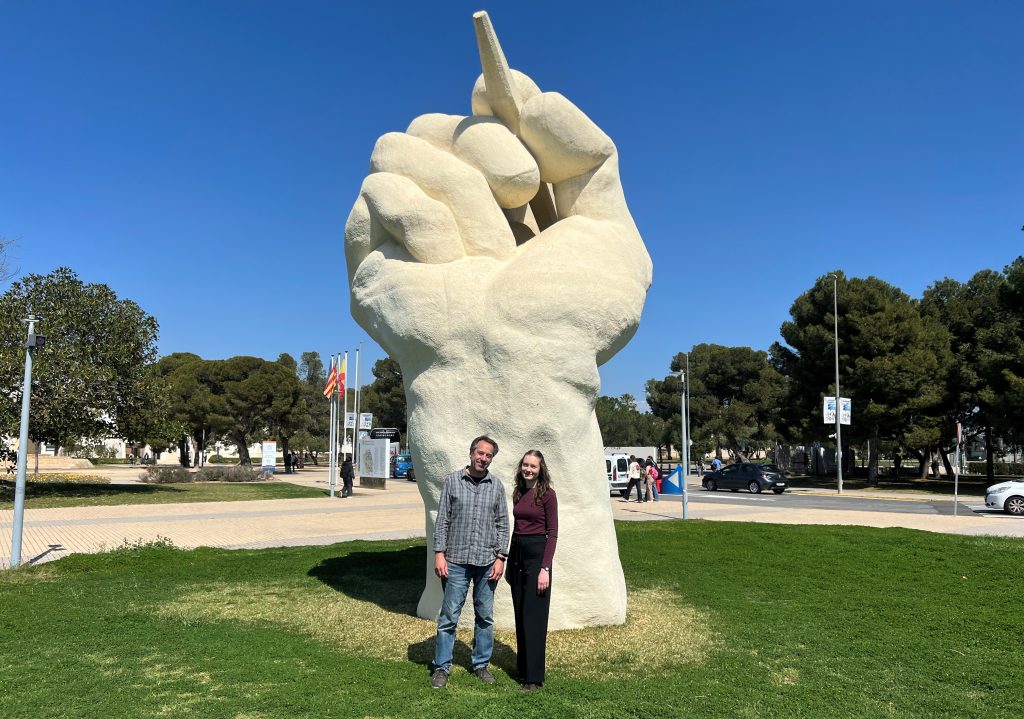
‘I learned about the possibility of pursuing a doctoral degree through the PhD Track programme from my academic supervisor. I appreciate the opportunity to give our project an international dimension at such an early stage. My adviser is Prof. José García-Rodríguez’, says Katarzyna Kusztal. ‘We met for the first time in March 2026, when I travelled to Alicante for two weeks. I presented my research and also received guidance and ideas on how to develop the methods I am working on. We are also planning a joint academic publication. We will be working on it during my next two-week visit, scheduled for October this year’, she adds.
Prof. Małgorzata Przybyła-Kasperek emphasises that the contact established earlier significantly helped to deepen this cooperation. ‘Our universities belong to the same alliance. This opens doors and makes it easier to trust one another. Initial contacts show whether we’ll work well together. We have fulfilled our agreements and shown that we can be relied upon. So when I mentioned my PhD student to the Professor, he didn’t hesitate; he immediately agreed to this form of cooperation.
The benefits are mutual. ‘On the one hand, we learn about new methods that we can introduce here in Poland. We also learn a great deal about implementing the solutions being developed. On the other hand, our contribution is also knowledge. “We brought” the theory of approximate sets by the Polish mathematician Zdzisław Pawlak to Spain, where it met with great interest. We have known and applied it for years, and now, thanks to our efforts, it will be used in other centres across Europe. In this way, we promote Polish science around the world’, she adds.
The researcher concluded with one further important aspect of cooperation:
‘The development of artificial intelligence in China and the United States is progressing at a tremendous pace. It is backed by massive financial resources that we do not have at our disposal. Working in smaller research centres in Europe, we have little chance of competing independently with the giants. I do believe, however, that this will change if we focus on close international cooperation – for example, through alliances such as Transform4Europe’.
| Author: Małgorzata Kłoskowicz |