

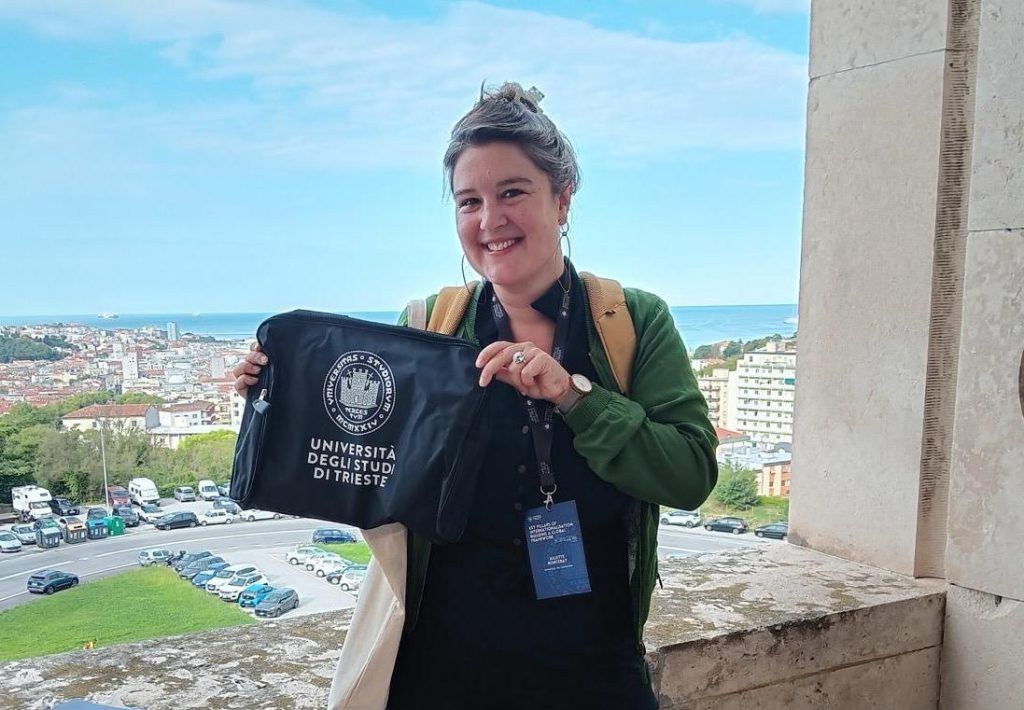
A T4EU Staff Week in Trieste turned into an unexpected journey into her own family heritage for Juliette Ronceray, a member of staff at the Centre for French Studies at Saarland University. She learnt that her roots go back to that Adriatic metropolis, which was once one of the most important trading centres of the Habsburg Monarchy. Her great-grandfather was born in the Trieste region around 1890. When the city became part of Italy after the First World War and the political situation grew increasingly unstable, he was forced to leave his homeland as a journalist with socialist convictions. Around 1920, Juliette’s great-grandparents therefore moved to Bregenz in Austria.
Her grandmother was born there in 1922. After the Second World War, she met a French soldier in Tyrol who was a regular at the concert bar where she played the piano. This encounter led to the creation of a family whose history spans Austria, France, Germany and beyond. Her grandfather’s military assignments took him to Vietnam, Savoy, Tunisia and, finally, the Saarland, amongst other places. Juliette’s father was born in Savoy in 1954. Through regular summer visits to his Austrian relatives, he learnt German and grew up surrounded by a variety of cultural influences.
Juliette herself has now been living in Germany for many years. Her time in Trieste made her realise just how closely her family’s history is intertwined with the major movements in European history: migration, political change, multilingualism and cross-border encounters. Her example shows that cultural heritage is preserved not only in buildings or archives, but also in the stories, memories and connections that are passed on from generation to generation.
Background information
Around 1890: My great-grandfather was born in the Trieste region.
From 1382 to 1918, Trieste was part of the Habsburg Empire and later of Austria-Hungary. The city was its most important trading port.
(Fun fact: as early as 1850, there was a direct train link from Vienna to Trieste – at a time when the railway network was still far from covering the whole of Europe.)
Around 1920: My great-grandparents were forced to flee to Austria, heading for Bregenz. Trieste had become part of Italy, and the political situation was very uncertain. Furthermore, my great-grandfather was a committed socialist and worked as a journalist. In this politically turbulent region, just as Mussolini was coming to power, this put him in danger.
1922: My grandmother was born in Bregenz. As a good pupil, she learnt French and the piano.
1945–1955: After the Second World War, Austria is occupied by the Allied forces who have liberated the country from the Nazi regime. Austria’s territorial boundaries are restored to those that existed prior to the ‘Anschluss’ to the German Reich in 1938, and the country is divided into four occupation zones.
My grandad was a French soldier and was stationed in Tyrol from 1945 onwards. There he met my grandmother, who played the piano in a concert bar. He didn’t speak German, but her French was good enough for them to communicate.
My grandfather stayed in Austria until 1950. After that, his duties took him to various places, which also paint an interesting picture of the geopolitical situation at the time: he was stationed in Vietnam until 1953, then briefly in the Savoy region of France, followed by a few months in Tunisia, and finally in St. Wendel in the Saarland from 1956 to 1959.
1954: My father was born in Savoy. As he visited his Austrian family every summer as a child with his mother and sister, he learnt German.
(My mother only learnt German at school. Today she is very keen to refresh her language skills, as her daughter – that’s me! – has been living in Germany for around 15 years.)
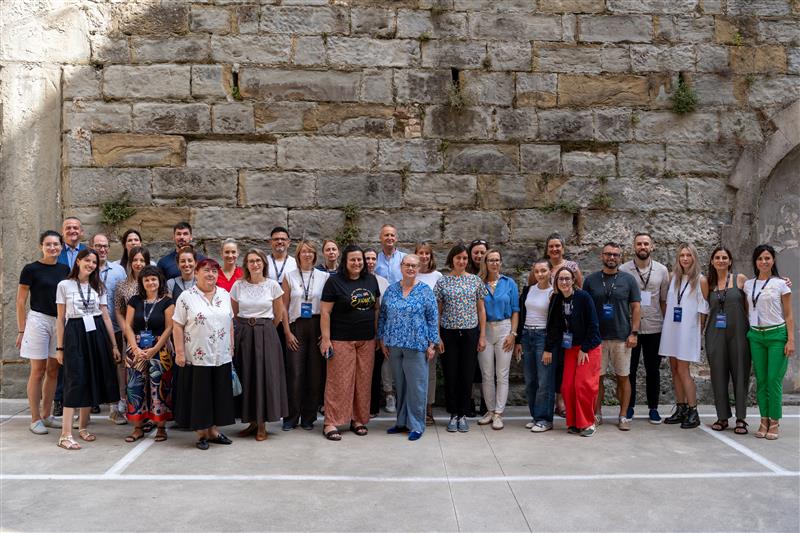
Staff Week in Trieste, 25-29 August, 2025 | Photo: J. Ronceray archive.