
Community, communities

Eengage to transform

About

Welcome to “Community. Communities” – a space dedicated to learning, knowledge-sharing, and transformation. Here, we explore the concept of “Community” through diverse, yet complementary perspectives and academic disciplines. This collection is an invitation to rethink the University not as an isolated institution, but as a living community thriving in, through, and for multiple interconnected communities. These articles and chapters were originally presented to the European University Transform4Europe (T4EU) in May 2026 during the T4EU Week in Lisbon.

Use the filters below to explore the collection.

Hanenberg, P., & Mendes-Palma, F. (Red.). (2026). Community, Communities: Engage to Transform. Universidade Católica Editora.
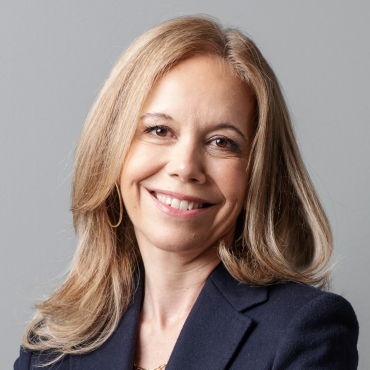
A woman with long blonde hair, wearing a dark blazer, smiles confidently at the camera against a plain gray background.
Isabel Capeloa Gil
Rector of Universidade Católica Portuguesa
Preface
Is there a global community? And what is the role of universities.
T4EU can be understood as a microcosm of what a global community might become – not a uniform structure, but a constellation of interconnected communities committed to the common good.

This preface explores the university as a dynamic community of knowledge that blurs the lines between organic social bonds and rational organization. It introduces the Transform4Europe (T4EU) alliance as a microcosm of a potential global community – a constellation of interconnected groups committed to the common good.
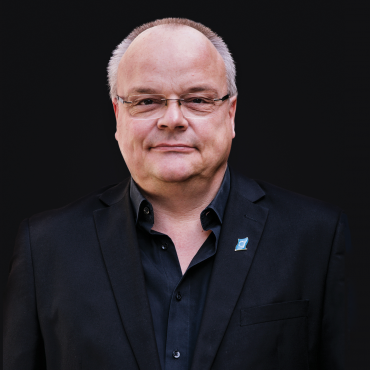
A middle-aged man with glasses and short gray hair is wearing a black suit jacket and black shirt, standing against a solid black background.
Peter Hanenberg
Vice-Rector of Universidade Católica Portuguesa
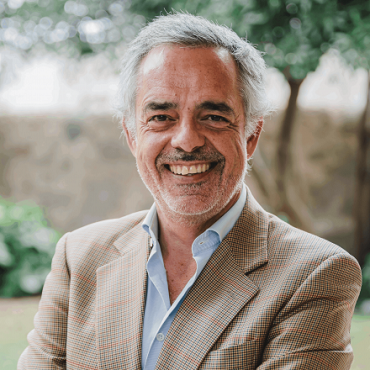
A middle-aged man with gray hair and a beard, wearing a checked beige blazer and blue shirt, smiles warmly while standing outdoors in a garden setting.
Francisco Mendes-Palma
Transform4Europe Coordinator. Católica Lisbon School of Business and EconomicsEditorial
Editorial
Community, communities: Editorial
The contributions to this volume have become an invitation themselves, an invitation to the reader to pick up those who might interest most.

The editors present this volume as an invitation from the Universidade Católica Portuguesa to reflect on the relationship between individual disciplines and the concept of “Community”. Rooted in the T4EU alliance, these diverse perspectives seek to understand the institution’s role within national and global contexts
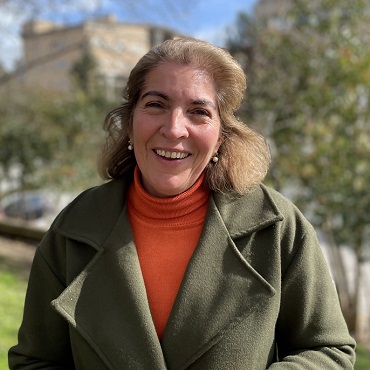
A woman with shoulder-length light brown hair, wearing an orange turtleneck and an olive green coat, smiles outdoors with greenery and buildings in the blurred background.
Maria Alexandra d’Araújo
Fellow of the Postdoctoral Programme in Integral Human Development at the Católica Doctoral School – CADOS
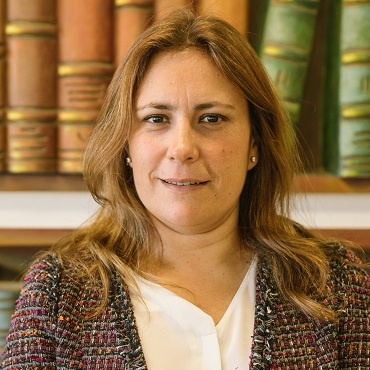
A woman with light brown hair, wearing a tweed jacket and white blouse, stands in front of a bookshelf filled with large, colorful books. She is looking at the camera and smiling slightly.
Maria Vânia da Silva Nunes
Associate Professor at the Faculty of Health Sciences and Nursin
Ageing
Ageing, Community and Belonging: University and the Transversality of Knowledge in the Promotion of Human Dignity
Community participation and social integration among older adults are associated with positive indicators of well-being, including greater life satisfaction and reduced depressive symptoms.

This article addresses demographic ageing as a major social transformation, highlighting how community engagement determines well-being. It proposes a university model that bridges academic research and professional elderly care, preparing younger generations for a society shaped by longevity.
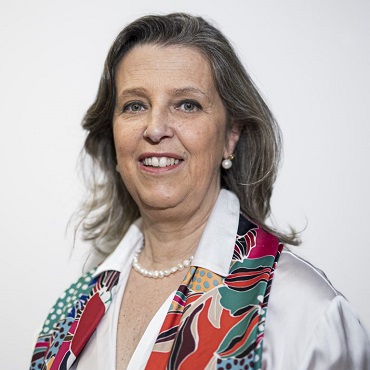
Smiling woman with gray hair wearing a white blouse, colorful scarf, pearl necklace, and pearl earrings, posing in front of a plain white background.
Maria Lopes Cardoso
Director of Partnerships, Alumni and Employability Alumni in Porto
Alumni
Community: Boomerang of Hope
Like a boomerang, the university experience returns with new questions, new knowledge, and renewed hopes.

Focusing on the lifelong bond between a university and its graduates, this text describes alumni as mediators who carry academic values into wider society. The relationship is compared to a “boomerang,” where the university’s values return enriched by the lived experiences of its alumni.
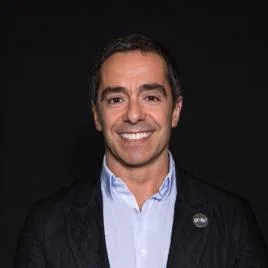
A man with short dark hair smiles, wearing a light blue shirt and a dark blazer against a plain black background.
Nuno Crespo
Dean of the School of Arts
Art
Art: Sharing the Common
The experience of art becomes a place for the reconfiguration of human experience of the world and […] the possibility of new ways of feeling and, of course, thinking.

This essay reflects on art as a space for building temporary communities through a shared “common sense” (sensus communis). It argues that art allows diverse individual subjectivities to manifest, creating a territory where cultural differences can coexist through empathy.
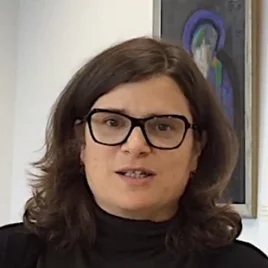
A person with shoulder-length brown hair and glasses wearing a black top stands indoors. A framed painting is visible in the background.
Maria José Correia
Associate Professor at the Faculty of Dental Medicine
Biomedicine
Community communities: what we can learn from microbes
Lessons learned from the microbe world might help us create sustainable and resilient communities free from destructive conflict, misinformation and extremism.

Drawing lessons from the microbial world, the author explores how cooperation and “quorum sensing” in microbes can inspire human organizational design. The text emphasizes that diversity increases resilience and that human communities should be built on mutual dependence.
A person with dark hair wearing a patterned scarf smiles outdoors in sunlight, with a blurred background featuring horizontal lines.
Paula Castro
Full Professor at the Faculty of Biotechnology
Biotechnology
From Hive to Biome: A Personal Reflection on Communities of Knowledge, Service, and Transformation
Knowledge is the collective refinement of attention; service is knowledge rendered shareable and actionable; transformation is the long arc of their circulation through linked communities.

A professional reflection on how community serves as the primary method for scientific transformation. The author discusses researching environmental biotechnology with rather than for communities, ensuring that scientific knowledge is rendered actionable for the global web of life.
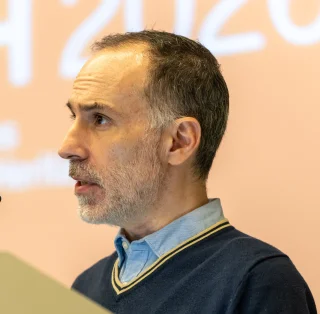
A man with short hair and a gray beard speaks at a podium with a microphone. He is wearing a collared shirt and sweater. The background is blurred with large white text on a peach-colored wall.
Daniel Ribas
Assistant Professor at the School of Arts
Cinema
Cinema as Community
Cinema as community is the place of encounter against a world of precarity, war, and lifeless places. Cinema as community is a possibility of what is yet to come.

From physical gatherings around projectors to modern classrooms, cinema is presented as an art of community and shared experience. The article argues that art schools foster a space where spectators debate cinema to imagine a more dignified, shared world together.
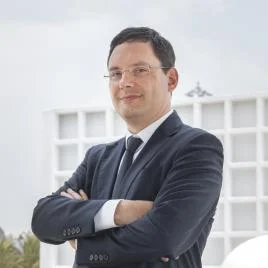
A man in a dark suit and tie stands with arms crossed, smiling slightly. He has short dark hair, glasses, and is outdoors with a modern white building in the background.
Nelson Ribeiro
Vice-Rector for Transformation, Collaboration and International Affairs
Communication
Media and the Construction of Communities
Media actively participate in the constitution of collective identities and collective forms of belonging, shaping the ways in which individuals imagine, experience, and narrate their experience.

Discussing Benedict Anderson’s “imagined communities,” this text examines how media actively participate in constituting collective identities. It warns that while digital platforms facilitate groups, algorithmic silos risk eroding social cohesion by creating informational echo chambers.
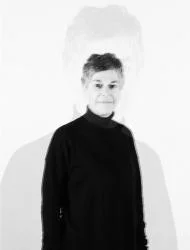
A grayscale image of a person with short hair wearing a dark top, standing in front of a light background. There is a faint, blurry duplicate silhouette behind them, creating a ghostly effect.
Laura Castro
Assistant Professor at the School of Arts and Researcher at the Research Centre for Science and Technology of the Arts
Conservation
The past as well as specific ancient sites and objects have been replaced and are renewed all the time
From fixing the past to negotiating futures; from authoritative intervention to shared decision-making; from an ideal of permanence to an acceptance of transformation as intrinsic to care.

This article posits that conservation is essentially a “conversation” that requires dialogue across disciplinary contexts. It argues for a shift from “fixing the past” to a socially embedded practice that accepts transformation as intrinsic to caring for cultural asset.
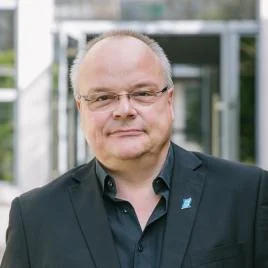
A middle-aged man with glasses and short hair, wearing a black suit and shirt, stands outside in front of a modern glass building, looking at the camera.
Peter Hanenberg
Vice-Rector for Research and Doctoral Education
Culture
Culture is, first of all, a set of practices shared by a group of people based on the affordances of their environment
We are cultural by nature – and thus there cannot be any human being and certainly no human community without culture.

Defining culture as practices shared by a group, the author discusses how education (Bildung) allows individuals to participate in specific cultural communities. The text advocates for a concept of culture where diversity is viewed as an opportunity for learning.
A man in a blue blazer and checked shirt looks to his side against a plain brown background.
Nuno Rosa
Associate Professor of the Faculty of Dental Medicine and Director of the Centre for Interdisciplinary Research in Health
A man with glasses, dark hair, and a slight smile is wearing a blazer and shirt, standing indoors with a blurred colorful banner in the background.
Nélio Veiga
Associate Professor of the Faculty of Dental Medicine and Coordinator of the 2nd cycle of studies at the Integrated Master’s in Dental Medicine
Dental
Beyond the Clinic Walls: A Mosaic of Smiles and Science
The student isn’t just checking teeth; they are encountering the reality of health inequalities. They learn to listen, to empathise, and to respect the diverse contexts of those they serve.

This text highlights how the Faculty of Dental Medicine acts as a bridge between high-tech research and regional health needs. It details outreach projects where students encounter health inequalities firsthand, evolving into agents of positive social change.
A man in a suit and tie stands in front of a bookshelf filled with books, looking at the camera with a slight smile.
William Hasselberger
Director of the Digital Ethics Laboratory
Digital
When Real People Use Digital Technologies to Create Synthetic Communities
Community cannot be substituted, nor loneliness ‘solved’ with a new app or algorithm.

The author examines the rise of “parasocial” relationships with AI chatbots, warning they can warp human expectations for social connection. The essay argues that AI simulations cannot substitute for genuine community bonds of mutual care.
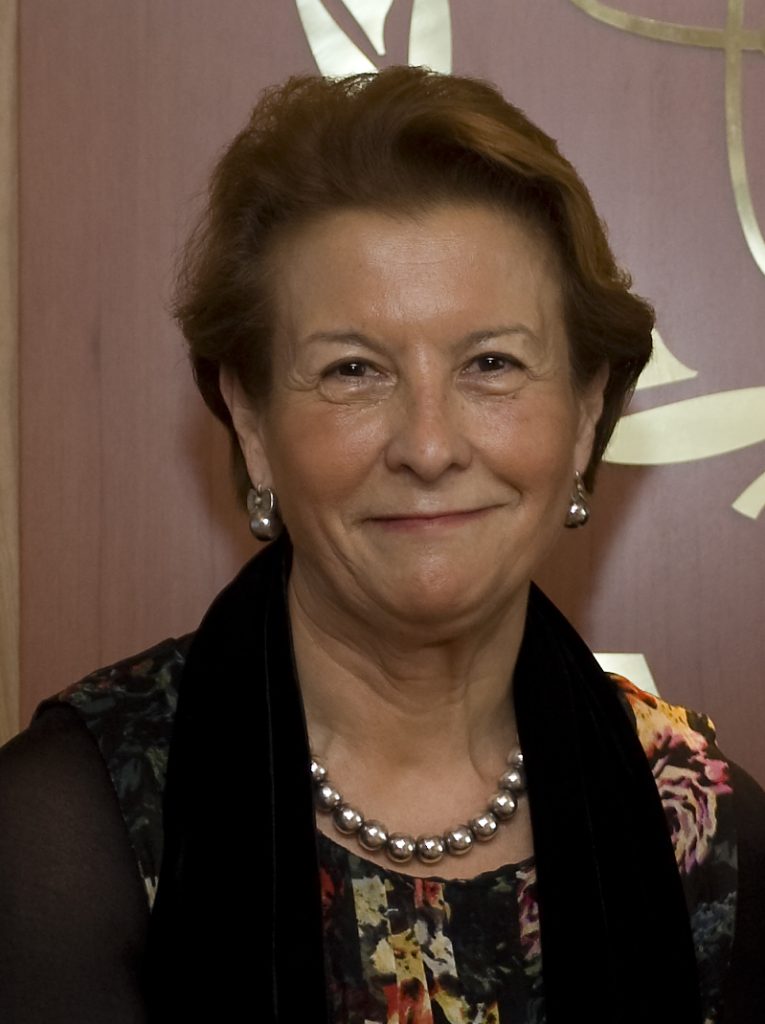
A woman with short brown hair wearing a floral dress, pearl necklace, and pearl earrings stands in front of a wooden background with gold detailing, smiling at the camera.
Ana Martinho
Portuguese Ambassador and Investigator at the Research Centre of the Institute for Political Studies
Diplomacy
Communities and Diplomacy: The University as Anchor and Choreographer of Knowledge
To choreograph knowledge is to place the human person at the centre of this movement, ensuring that harmony serves dignity and fulfilment.
This article views the university as a “community of communities” where diplomacy is the internal art of building bridges across differences. It uses the metaphor of “choreography” to describe how the university coordinates diverse elements to serve human dignity.
A man in a dark suit and tie poses against a plain gray background, looking at the camera with a neutral expression and his arms crossed.
João Confraria
Senior Affiliate Professor at Católica Lisbon School of Business and Economics
Economics
A core contribution of Economics to public decision-making is a concept of efficiency
Markets are often inefficient, there are market failures, which provide a rationale for government regulation. As a matter of fact, government regulation is an indispensable condition for the market economy.

Addressing the “dismal science” of scarcity, the author explains how economics contributes efficiency concepts to public decision-making. The text navigates the role of markets, the necessity of government regulation, and the ethical dialogue required to address inequality
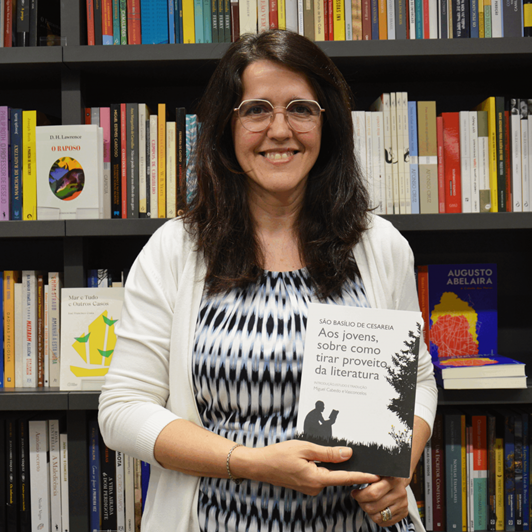
A woman with long dark hair and glasses smiles while holding a book in front of a bookshelf filled with colorful books.
Anabela Antunes
Publishing Director at UCP Press
Editions
Books – in whatever form – preserve the past, respond to the present and prepare us for the future
Books – in whatever form – preserve the past, respond to the present and prepare us for the future.

UCP Press is presented as a service to the community of researchers and learners. The article discusses the transformation toward Open Science and e-books, reinforcing the idea that knowledge is a social right that prepares us for the future.
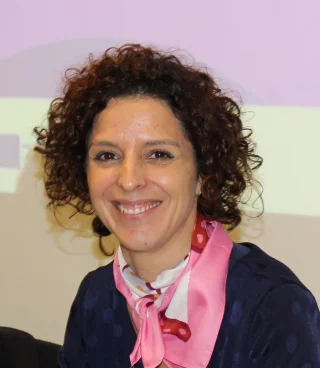
A woman with curly brown hair smiles at the camera. She is wearing a navy polka-dot top and a white scarf with pink and red details. The background is softly lit in pastel colors.
Diana Soares
Assistant Professor at the Faculty of Education and Psychology
Education
And, what if we try this together? A community-driven approach to sustain Pedagogical Change
Rather than reflecting in isolation, we can reflect together, test new models together, and learn from one another.

This essay explores the value of community-driven transformation in teaching practices. Using Kotter’s change model, it outlines how connecting faculty across departments can create a shared institutional commitment to lasting educational change.
A young man with brown hair and a beard, wearing a dark suit, white shirt, and red tie, smiling at the camera against a light background.
João Cotter Salvado
Assistant Professor at Católica Lisbon School of Business & Economics
Entrepreneurship
Community as the living infrastructure of Entrepreneurship
The idea of community is not peripheral to entrepreneurship: it is the infrastructure that enables it.

Challenging the myth of the lone visionary, the author argues that entrepreneurship is fundamentally a community-embedded process. Communities provide the knowledge, legitimacy, and emotional scaffolding necessary for new ventures to move to shared reality.
A woman with shoulder-length brown hair, wearing a gray collared shirt, stands outside and smiles at the camera. Green leafy trees fill the background.
Mara de Sousa Freitas
Associate Professor at Católica Medical School
Ethics
Ethics, a lived, relational, and transformative force
Words become binding only when grounded in ethical commitment and embodied in action. Communities endure through lived responsibility.

Ethics is presented as the foundation for human flourishing (eudaimonia) within shared communities. The author argues that ethical service—directing knowledge toward the common good—is a condition that allows communities to exist as spaces of trust.
A woman with dark hair, wearing a black top, smiles at the camera in front of a light-colored background.
Paula Teixeira
Full Professor at the Faculty of Biotechnology
Food Safety
Food Safety implies the availability of diverse, nutritious, and safe food for all
We view food safety not merely as a technical requirement, but as a communal pact. ‘If it is not safe, it is not food’.

The Faculty of Biotechnology views food safety as a communal pact. This text describes how researchers collaborate with hospitals and industry to protect public health, translating complex science into daily hygiene habits for vulnerable populations.
A woman with short brown hair, glasses, and a patterned top smiles while standing with arms crossed in front of a plain light-colored background.
Marília dos Santos Lopes
Associate Professor with Aggregation at the Faculty of Human Sciences
History
Seeking community through History. The Portuguese Case
What transforms a collective into a community are interpersonal relationships and the sharing of experiences.

Exploring “imagined communities,” the author examines how Portuguese identity has been shaped by historical and cultural factors. The text highlights language and migration as unifying elements that maintain collective memory across history.
A woman with shoulder-length dark hair smiles, wearing a white shirt with a red and black patterned sweater. She stands in front of a bookshelf filled with large, colorful books.
Zaida Borges Charepe
Associate Professor at the Faculty of Health Sciences and Nursing – Lisbon and at the School of Nursing – Lisbon
Hope
Hope: A Transformative Concept
Hope constitutes an active and relational process through which communities generate opportunities for change, strengthen collective capacity, and maintain a commitment to transformation.

Hope is defined as a fundamental human need involving the co-creation of future possibilities. The author discusses hope-based interventions (like Hope2Care) that enhance health outcomes, positioning hope as a catalyst for social justice.
anonymous woman
Ana Ortigão Sampaio
Director of Human Resources
Human Resources
Building and nurturing a community of interconnected communities
Working at the university is, in itself, a continuous learning process.

This article explores the university’s role as a responsible employer that attracts talent aligned with its mission. It discusses the challenge of bringing five generations together and the importance of caring for people as the heart of a community.
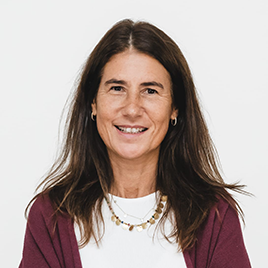
Woman with long brown hair, wearing a maroon cardigan, white top, and gold necklace, smiling against a plain white background.
Carmo Themudo
Coordinator of the Integral Development of the Person Unit
Inclusion
“No one is saved alone; it is only possible to be saved together.”
True human development is only possible when diversity is welcomed and valued. Inclusion means opening doors, but also building bridges.

Drawing on Pope Francis’s vision, this text argues that human development is only possible when diversity is welcomed. It describes inclusion as a commitment to building bridges and recognizes that the participation of the most vulnerable is essential.
anonymous man
Pedro Azevedo
Head of Real Estate and Infrastructure
Infrastructure
Beyond buildings: University Infrastructure as an academic life model
A University’s Infrastructure is its most palpable and visible ethical statement.

Infrastructure is presented as a parameter that actively shapes academic behavior and values. The article discusses UCP’s commitment to “green” campuses and open spaces that foster casual conversation and cross-disciplinary collaboration.
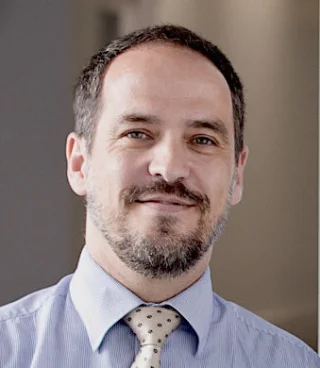
A man with short dark hair and a beard is smiling. He is wearing a light blue dress shirt and a cream-colored tie with small dark shapes. The background is softly blurred.
João Cortez
Director of the Research and Innovation Office
Innovation
Communities of Change: Innovation through connected actors and shared purpose
Success should be assessed beyond patents or investment attracted, considering also improved well-being, more effective public services, more humane organisations, and stronger communities.

For UCP, innovation is a multidimensional endeavor oriented toward positive transformation. The text highlights social innovation projects that frame challenges alongside those who experience them to create tangible human value.
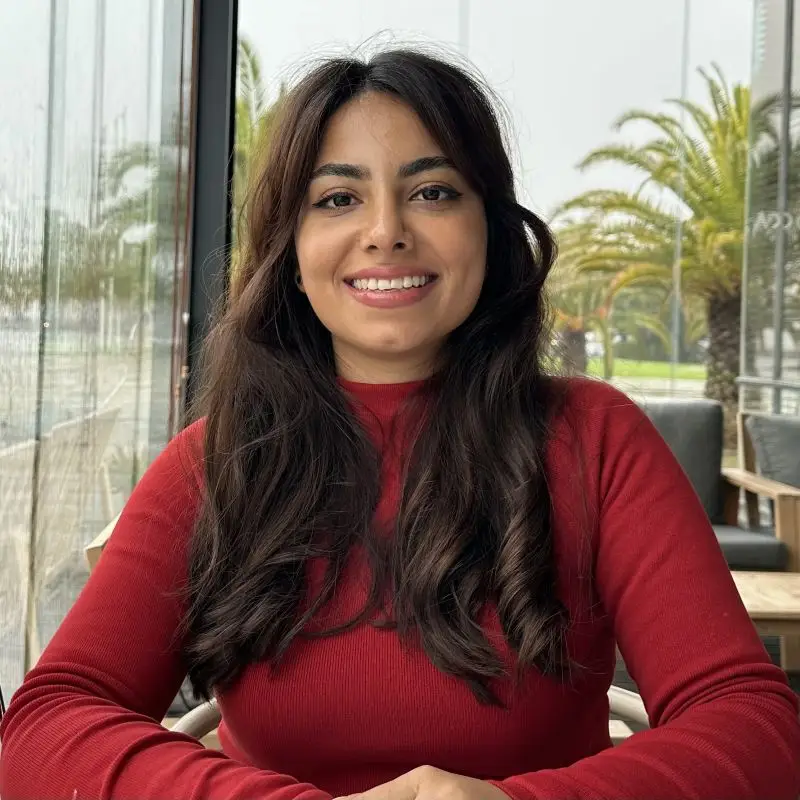
A woman with long dark hair and a red top sits at a table in a cafe, smiling at the camera. Palm trees and large windows are visible in the background on a cloudy day, setting the scene for a Transform for Europe gathering.
Mahsa Farrokhi
International Student at UCP
International Students
Community, Communities: A Journey of Knowledge, Belonging, and Transformation
Community is not simply found; it is actively shaped through connections, shared goals, and openness.

An international student shares how community is shaped through participation in knowledge creation. The research lab becomes a “community of practice” where multicultural exchange transforms individual academic paths into global belonging.
A middle-aged man with gray hair and a beard, wearing a checked beige blazer and blue shirt, smiles warmly while standing outdoors in a garden setting.
Francisco Mendes-Palma
Institutional Coordinator for Transform4Europe at Universidade Católica Portuguesa and Invited Professor of the Executive Programs of Católica Lisbon School of Business and Economics
Internationalisation
Internationalisation: to travel and to learn
Internationalising is a way of living. It means recognising that every activity has an international dimension.

Internationalisation is described as a way of living that acknowledges the universal dimension of human activity. The author argues that universities play a key role through Science Diplomacy—promoting cooperation between diverse global communities.
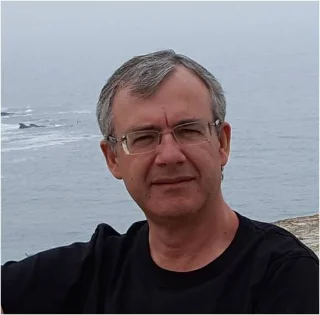
A middle-aged man with short gray hair and glasses sits outdoors near the ocean, wearing a black shirt. The background shows a cloudy sky and waves in the distance.
Augusto Soares da Silva
Full Professor at the Faculty of Philosophy and Social Sciences
Language
Language in the mind and in the community
Languages live in the mind but belong to communities.

This article explores language as a social reality shaped by cognitive processes. It discusses the pluricentric nature of Portuguese and how research can inform policies for more inclusive migrant integration.
A woman with shoulder-length brown hair, wearing a white top, stands in front of a light-colored wall, smiling gently at the camera.
Maria da Glória Garcia
Full Professor at the Faculty of Law
Law
Católica Law Community – Four Steps
Portugal needed a strong and healthy law community to build the welfare state based on dignity, human rights and duties, and on social principles.

Tracing the history of UCP’s law community since 1976, this text outlines its evolution into a hub for global legal education. It highlights the school’s role in training professionals who serve society based on principles of human dignity.
An older man with curly gray hair and glasses, wearing a dark suit and white shirt, stands smiling in front of a white building with windows.
Fernando Ilharco
Associate Professor at the Faculty of Human Sciences
Leadership
Leadership: The Performance of the Community
To lead is to be followed.

This essay examines leadership as a phenomenon rooted in the group, where the “emotional bond” is central. It argues that effective leadership relies on a balance between technical competence and a sustained focus on good relationships.
anonymous woman
Ana Folque Gouveia
Director of the John Paul II University Library
anonymous man
Bruno Marçal
Deputy Director of the John Paul II University Library
Library
Libraries for Community
Libraries play a strategic role […] in the defence and preservation of the way of life that characterizes our societies.

University libraries are described as living organisms that become promoters of inclusive structures. The text highlights their role in helping users navigate AI and Open Science while building networks that ensure stability in times of uncertainty.
A woman with short, light brown hair wearing a navy blazer and white top stands with arms crossed, smiling confidently against a plain gray background.
Céline Abecassis-Moedas
Associate Professor with Aggregation and the Founder and Academic Director of the Center on Longevity Leadership at Católica Lisbon School of Business & Economics and Pro-Rector for Innovation and Entrepreneurship
Longevity
Living to 100: The impact of Longevity on Business, Workforce, and Learning
Longevity invites us to rethink the entire life course, from education to work, from consumption to retirement.

Longevity is a structural transformation calling for a “new map of life” beyond linear models. This article discusses business opportunities of the silver economy and the university’s role as a lifelong companion for upskilling in an era of extended lifespans.
A man in a navy suit and white shirt stands indoors with arms crossed, smiling at the camera. He is wearing a smartwatch and appears confident and approachable.
João Pinto
Associate Professor at Católica Porto Business School
Management
Community as a Regenerative Force: Leadership for Sustainability in a University Ecosystem
Leadership for sustainability is inherently relational. It is less about authority than about catalysis: creating the conditions for others to act, connect, collaborate, and imagine new possibilities.

Focusing on InSuRe.hub, this text presents the university as an ecosystem of regenerative leadership. It argues that sustainability requires a shift to circular reasoning, creating communities that orchestrate strengths toward planetary thriving.
anonymous woman
Ana Vidal
Institutional Marketing and Communication Director
Marketing
Community; Communities: The Transformative Role of Marketing
Marketing activity should inspire students, alumni, researchers, and staff, reinforcing their role as agents of change.

Marketing is redefined as a strategic tool for developing causes grounded in the common good. The author explains how UCP uses marketing to inspire students as agents of change, reinforcing their sense of belonging to a “community of communities.
A man with short brown hair, wearing a light blue button-up shirt, stands smiling with arms crossed against a plain light blue background.
António de Almeida
Full Professor at Católica Medical School
Medicine
Building the Community at Católica Medical School
Medical students learn to be part of a community, to serve a community, and to grow within a community.

Medicine is presented as a vocation centered on collaboration. The author describes how UCP uses Problem-Based Learning to foster a medical community that works with society, prioritizing prevention and human awareness.
A woman with straight brown hair, wearing a black top and a beaded necklace, smiles at the camera against a plain white background.
Luísa Vieira de Campos
Assistant Professor at the Faculty of Education and Psychology
Mental Health
Tolerance, Tolerances, Complicity
Long before anyone seeks professional support, mental health is already being influenced by what is permitted, rewarded, ignored, or silenced.

This article explores how mental health in academic communities is shaped by daily practices. It warns that silence toward harmful behavior can erode psychological safety, calling for collective accountability to protect the well-being of those who inhabit them.
A woman with dark hair smiles at the camera, wearing a white and black jacket and earrings, with a blurred outdoor landscape in the background.
Célia Manaia
Full Professor at the Faculty of Biotechnology
Microbiology
The language of communities: microorganisms as an inspirational model
Shared capacity for learning and adaptation underscores the importance of ‘interconnectedness’, ‘cooperation’, and ‘resilience’ across scales of life.

Microbial communities thrive through cooperation and dynamic balance—principles that mirror successful human organizations. The author argues that studying how microbes manage resilience can inspire public health strategies and sustainable collaborative environments.
A smiling man with gray hair and a beard, wearing glasses, a gray suit, and a blue striped tie, stands in front of a bookshelf filled with large, colorful books.
Alexandre Castro Caldas
Invited Full Professor at Católica Medical School
Neuroscience
Still taking the first steps
Knowledge increasingly demands transdisciplinarity.

Neuroscience is described as a field still in its early stages, delving into human nature through consciousness. The author touches on the intersection with AI and emphasizes that interdisciplinary knowledge is required to solve the complex puzzle of neural function.
A woman with shoulder-length gray hair, wearing a green blouse and dark blazer, smiles while sitting in front of bookshelves filled with large, colorful books.
Amélia Simões Figueiredo
Associate Professor at the Faculty of Health Sciences and Nursing
Nursing
Operating local transformation with associated territorial development
The community spirit is translated into knowledge, into service, and we operate local transformation with associated territorial development.

Nursing at Católica is presented as a community that promotes the transfer of knowledge to society. The text lists projects (like “Empower to Save”) that empower vulnerable populations, translating nursing care into concrete social service.
A woman with long dark hair, wearing a brown sweater and black shirt, stands indoors in front of a wooden wall with various plaques and papers displayed behind her.
Ana Gomes
Associate Professor at the Faculty of Biotechnology
Nutrition
There are ideas that only flourish when they find common ground
Nutrition is rigour that cares, proximity that educates and partnerships that multiply.

Nutrition is presented as a language of belonging that transforms scientific evidence into shared health choices. Through community-based projects like “NUTRIAGE,” nutritionists act as agents of care, recognizing that individual health is inseparable from the health of the plane.
anonymous man
Bruno Marçal
Deputy Director of the John Paul II University Library
Open Science
An opportunity for joint reflection on communities’ structural and emerging topics
Open Science arises as an aggregating framework for a broad ecosystem designed to benefit researchers, institutions, and, to a significant extent, society.

Open Science is a catalyst for transparency, democratizing access to knowledge beyond rigid commercial models. The author discusses UCP’s efforts to implement collaborative environments (like T4EU), introducing researchers to a culture of shared knowledge.
anonymous woman
Rita Bacelar
Director of the Global Engagement Office
Partnerships
Large and small communities coexisting to strive
Within this big community, hundreds of big and small communities coexist aiming to see it strive.

The Global Engagement Office facilitates collaborations between UCP’s internal communities and hundreds of universities worldwide. By supporting partnerships, the office encourages a multicultural environment where respect and knowledge are shared values.
A man with short dark hair, glasses, and a serious expression is wearing a white button-up shirt and a dark blazer, seated against a plain light-colored wall.
Bruno Nobre sj
Dean of the Faculty of Philosophy and Social Sciences
Philosophy
Philosophy – community
Philosophy can reflect on community, but it can also help create the conditions under which healthy political and human communities may flourish […] in which diversity is not experienced as a threat.

Philosophy is framed as a communal “way of life” and a bridge among specialized forms of knowledge. The author argues that philosophical reflection provides the depth needed for healthy, diverse communities to flourish in an era of AI and social tension.
Woman with long dark hair, wearing a teal jacket and a pearl necklace, standing in front of a bookshelf filled with books.
Mónica Dias
Director of the Institute for Political Studies and Senior Researcher at the Research Centre of the Institute for Political Studies
Politics
Restlessness and Rupture: The crisis of community in a turbulent world
The crisis of politics is also a crisis of communities.

This essay analyzes pressure on liberal democracies and the concept of community. It advocates for “inclusive communitarianism”—a platform for cooperative inquiry and democratic participation—to tackle feelings of disempowerment in a turbulent world.
A woman with long, wavy red hair and fair skin wears a black top and a delicate necklace, standing against a plain white background, looking at the camera with a subtle smile.
Raquel Matos
Associate Professor at the Faculty of Education and Psychology
Psychology
Empowering communities through psychology education
Knowledge only becomes meaningful when it is connected to peoples lived experiences and contributes directly to the wellbeing of communities.

Psychology at UCP aims to train professionals committed to social justice and human dignity. The author describes psychology as a practical tool for building resilient communities, drawing from her journey investigating gender inequalities and the justice system.
A woman with shoulder-length dark hair, light skin, and wearing a sleeveless dark top, looks at the camera with a neutral expression against a light background.
Luísa Mota Ribeiro
Assistant Professor at the Faculty of Education and Psychology and Responsible for the UCP’s CApS Initiative
Service-Learning
Beyond the Classroom: The Transformative Role of Service-Learning in the Community
If I had to choose a single word to describe what service-learning means to me, I would say: CONNECTION.

Service-learning is described as a pedagogical tool for “connection”—with oneself and others. Using the four elements as metaphors, the author illustrates how students root their learning in the lived realities and needs of communities.
A woman with straight brown hair, wearing a sleeveless lavender top and a colorful beaded necklace, smiles at the camera. The background is bright with large windows.
Ana Maria Oliveira
Assistant Professor at the Faculty of Human Sciences
Social Work
Community as Relation: Social Work and the University as a Living Community
Community, then, is not a static noun. It is a verb, a continuous practice of relating, caring, negotiating and collectively constructing social life.

In social work, community is a living fabric of bonds. The article highlights how the university co-produces knowledge with communities, training professionals to build bridges and facilitate collective processes for social transformation.
anonymous woman
Francisco Afonso
student of the Integrated Masters in Medicine
Students
Student life: service, responsibility, and hope as dimensions of knowledge
Education is understood as something practiced collectively, rather than accumulated individually.

Student life at UCP is portrayed as a “community of communities” where service and ethics are integral to learning. Through volunteering and student-led structures, students develop the responsibility needed to become “entrepreneurs of dreams.
A woman with long brown hair, wearing a beige blouse and a necklace, stands indoors and smiles at the camera.
Isabel Braga da Cruz
Pro-Rector for Sustainability and Porto Regional Centre
Sustainability
Sustainability as a Mission, Not as a Trend!
Knowledge must serve life.

UCP views sustainability as “care for our common home,” integrating ecological preservation with social justice. The text details how the university embeds the SDGs into its mission through “Green Campus” initiatives to shape sustainable citizens.
anonymous man
Adriano Serrano
Chief Digital Officer
Technology
Bringing projects and communities together
The technological component […] needed to implement a series of projects to transform its technological infrastructure and application systems […] Bringing projects and communities together.

This section outlines the technological transformation at UCP required for the T4EU project. It details the integration of authentication infrastructures and platforms like MetaCampus to enable seamless collaboration across the university’s communities.
A man with short dark hair and a trimmed beard, wearing a dark blazer over a blue shirt, smiles outdoors with trees and greenery in the background.
Alexandre B. Palma
Bishop, Associate Professor at the Faculty of Theology
Theology
Theology: a Communal Enterprise
Theology aims at communion as a higher form of community.

Theology is presented as an inherently communal act that addresses the shared religious experience of humanity. The author explains how theology seeks “communion” as a higher form of community, highlighting the fundamental questions that make us one.
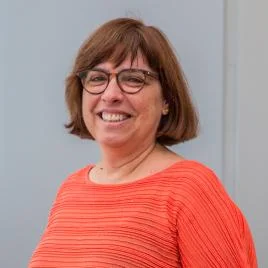
A woman with short brown hair and glasses smiles while wearing an orange textured top, standing in front of a plain light gray background.
Alexandra Lopes
Associate Professor at the Faculty of Human Sciences
Translation
translation and/as community
Without translation, and the willingness to translate ourselves, others, and the world, there is no community.

Translation is described as the “language of languages”—a hermeneutic activity that produces community by allowing human beings to translate themselves for others. The essay argues that creativity results from the translation of plural views rather than singular originality.
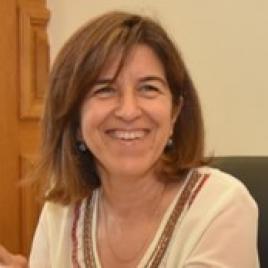
A woman with shoulder-length brown hair, wearing a cream-colored blouse with embroidered details, is smiling while seated indoors near a wooden panel.
Margarida Mano
Vice-Rector for Continuous Improvement and Development
Transparency
Transparency and Community
Institutional secrecy seldom protects; more often, it weakens.

Transparency is identified as a substantive element of governance that generates trust. The author argues that a culture of transparency is an ethical infrastructure essential for a cohesive community and shared commitment to the common good.
anonymous woman
Rita Paiva e Pona
Social Responsibility Office Coordinator
Volunteering
What Does Volunteering Reveal About the University as a Community?
Volunteering reminds academic institutions that learning is not shaped by reflection alone, but also by proximity, attention and experience.

Volunteering is a practice of service and encounter that reveals the university’s role as a neighbor to others. The article argues that volunteering deepens educational responsibility by bringing ideas into dialogue with reality.
Four rounded white squares are arranged in a grid pattern on a light gray background, with space separating each square.