

Apply Now: Creativity Week at Universidade Católica Portuguesa
Apply Now: Creativity Week at Universidade Católica Portuguesa
12-16 October 2026 | Universidade Católica Portuguesa, Braga (Portugal)
About
Universidade Católica Portuguesa is organizing Creativity Week, an intensive academic and interdisciplinary event, in Braga from 12 to 16 October 2026. The topic of Creativity will bring together students, PhD candidates, early-stage researchers, academic and non-academic staff, schools, companies and external stakeholders from across the Transform4Europe community.
The central topic of the Creativity Week is creativity as a human, cultural, and transformative force. The programme will explore creativity from philosophical, artistic, scientific, educational, social and technological perspectives, paying particular attention to its role in the twenty-first century.
Creativity and Artificial Intelligence, Creativity and Conflict Resolution and Creativity towards Sustainability and Social Transformation are the three major thematic challenges who will guide the discussion.
The Creativity Week will include three different Transform4Europe activities: Matchmaking for Excellence, designed to foster academic networking, identify shared research interests and support future joint initiatives; a PhD Conference, where doctoral candidates and early-stage researchers will present their work; and a Summer School, designed for doctoral and postdoctoral researchers.
The final programme will be announced shortly.
Participants will be selected based on dedicated calls at partner universities. Please, contact your local T4EU office to find out more details about the application for the event.
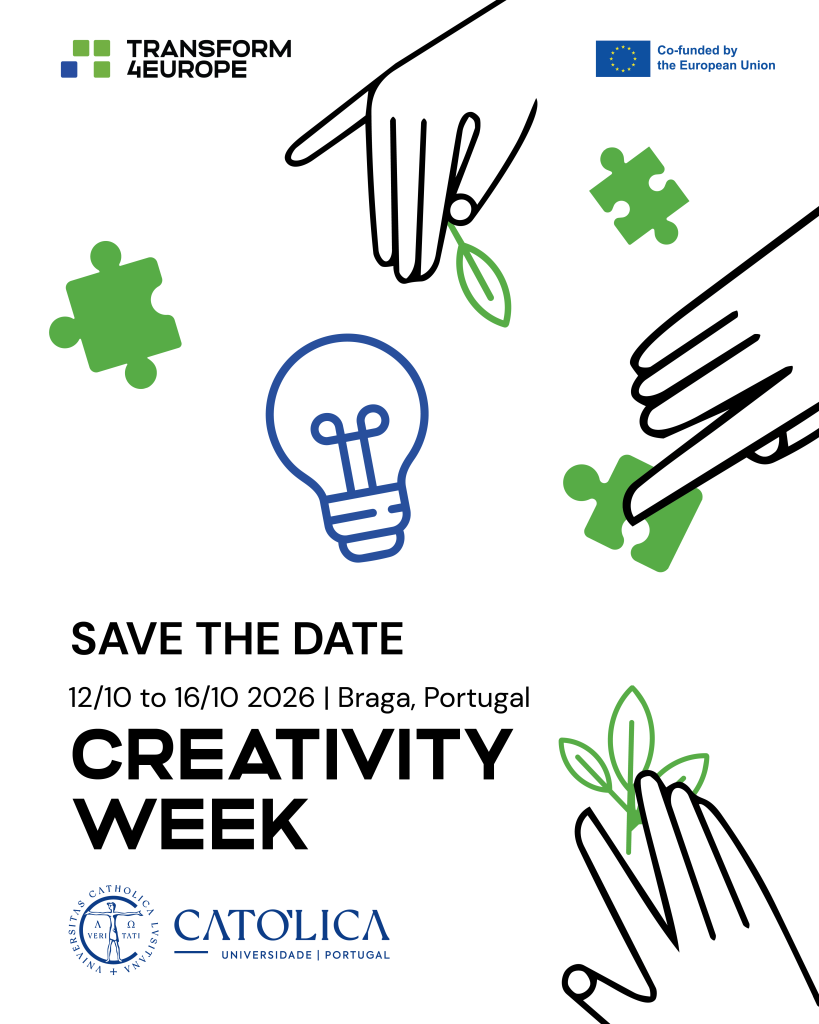
The Creativity Week will focus on creativity as a central topic for understanding human action, culture and knowledge. Creativity is often associated with imagination, artistic expression, invention or scientific discovery, but it can also be understood more broadly as the capacity to perceive possibilities, develop new connections and respond to problems in ways that are not merely repetitive. For this reason, creativity is relevant not only to the arts, but also to education, research, technology, social life and institutional change. The programme of the Creativity Week will therefore approach creativity both as a concept to be examined critically and as a practice that can be applied to contemporary challenges.
Current social, technological and environmental changes have made creativity an important topic for universities and for society more broadly. The development of artificial intelligence raises new questions about imagination, authorship, originality, and human agency. At the same time, contemporary challenges such as conflict, sustainability, democratic participation, and social innovation require the ability to formulate problems differently and to explore alternatives. The programme will consider how creativity can contribute to these discussions, while also examining its limits, its conditions, and its specific role in human and institutional contexts.
The Creativity Week will address these questions through a programme that combines philosophical reflection, interdisciplinary research, applied workshops, collaborative laboratories, and engagement with real-world contexts. The aim is to create a space in which participants can think critically about creativity while also practising it as a method for inquiry, cooperation, and transformation.
The central theme of the Creativity Week is creativity as a human, cultural, and transformative force. The programme will explore creativity from philosophical, artistic, scientific, educational, social and technological perspectives, paying particular attention to its role in the twenty-first century.
The Week will be structured around three major thematic challenges:
- Creativity and Artificial Intelligence
Participants will explore how artificial intelligence reshapes our understanding of imagination, authorship, originality, agency and human distinctiveness. This theme invites critical reflection on whether machines can be creative, what kinds of creativity AI may simulate or support, and how human creativity can be preserved, expanded and reinterpreted in technologically mediated environments. - Creativity and Conflict Resolution
Creativity will also be approached as a resource for dialogue, mediation, democratic engagement and social repair. This thematic axis will examine how creative practices can help individuals and communities respond to disagreement, polarization, violence, cultural conflict, and institutional fragmentation. - Creativity towards Sustainability and Social Transformation
A third focus will consider creativity as a driver of sustainable change. Participants will reflect on how universities, researchers, students, schools, companies, and regional stakeholders can work together to imagine and develop new responses to ecological, societal, and institutional challenges.
The Creativity Week will combine academic, practical, collaborative and cultural formats. The programme will include keynote lectures with international speakers, thematic workshops, interdisciplinary working groups, Creativity Labs, public-facing sessions, presentations of projects, feedback moments and opportunities for structured and informal networking.
The Creativity Week will also include a Blended Intensive Programme (BIP), bringing together virtual and in-person learning activities.
A distinctive feature of the Creativity Week will be the connection between conceptual reflection and concrete contexts of action. Participants will not only discuss creativity as an abstract idea; they will be invited to use creative methods to address problems, develop proposals, test collaborative approaches and exchange perspectives with peers, teachers, researchers and external partners.
Programa SC de T4EU@UCP
The Creativity Week will also contribute to the doctoral, research and innovation ecosystem of the Transform4Europe Alliance. Several activities will be connected with doctoral education, early-stage research and the development of collaborative academic networks.
- The PhD Conference will provide space for doctoral candidates and early-stage researchers to present their work, discuss ideas, receive feedback and establish international academic connections within the Alliance.
- The Matchmaking for Excellence activity will promote academic networking among researchers and staff from T4EU partner universities, helping to identify shared interests, potential collaborations and future joint initiatives, including research projects, training programmes, innovation activities and funding opportunities.
- The Summer School dimension will focus on skills development, institutional support and career orientation for doctoral candidates, postdoctoral researchers, and young academics. It will contribute to the exchange of good practices across partner universities and to the development of a more transparent and collaborative environment for academic career development within T4EU.
The Creativity Week is conceived also as a living laboratory for the University itself. It asks how creativity can become part of the way universities teach, research, collaborate and serve society. It also reflects the broader ambition of the Transform4Europe Alliance, to connect knowledge, responsibility, innovation and social impact across European regions.
By bringing together philosophy, the arts, literature, science, technology, education, business and civic engagement, the Creativity Week will create a shared and interdisciplinary environment for critical reflection and practical experimentation. It will invite participants to move beyond disciplinary boundaries, to work with others, to confront complex problems and to imagine new forms of personal, institutional, and social transformation.
For information on accommodation and travel, visit the Universidade Católica Portuguesa website.
- Oct 12 - 16 2026
- Expired!
- All Day
- conference,
- workshop
- Braga, Portugal
- Universidade Católica Portuguesa