
Between Coal and Silicon: A Conversation with Acclaimed Artist Zach Blas on His VMU Visit, Living in Contradictions, and the Pessimism of the AI Era
About
Between Coal and Silicon: A Conversation with Acclaimed Artist Zach Blas on His VMU Visit, Living in Contradictions, and the Pessimism of the AI Era
One of the most prominent voices in media art and technology criticism is arriving at the Vytautas Magnus University Faculty of Arts through the Transform4Europe visiting professor program. A conversation about the limits of Silicon Valley critique in Eastern Europe, growing up in Appalachia, the importance of concepts in art, and the pessimism and hope of the AI era.
Zach Blas (b. 1981) is an artist, filmmaker, and theorist working at the intersection of media art, queer theory, and the critique of technology. He is Associate Professor of Visual Studies at the University of Toronto’s Daniels Faculty and holds a PhD in Literature from Duke University. His works have been exhibited at the 2026 Whitney Biennial, the 12th Berlin Biennale (2022), the 2018 Gwangju Biennale, as well as at Tate Modern, the Walker Art Center, ZKM, MoMA PS1, and the de Young Museum. In 2025, Duke University Press published the collected volume “Informatics of Domination”, co-edited by Blas with Melody Jue and Jennifer Rhee. The concepts he has developed – “informatic opacity,” “contra-internet,” “utopian plagiarism,” “metric mysticism” – are now firmly embedded in the international vocabulary of media art and theory.
The conversation took place two weeks before his residency at Vytautas Magnus University’s Faculty of Arts. Blas’s visit is organised through the Transform4Europe (T4EU) Alliance visiting professor program. T4EU brings together eleven European universities aiming to strengthen academic exchange and mobility between major European centres and smaller ones. VMU has been part of the alliance since 2020.
During his two-week residency, Blas will lead intensive seminars for students and deliver a public lecture. The principal student groups are master’s students from the Intermedia Art and Creative Industries programs. The public lecture is open to all and will take place on May 21, 6 p.m., at the VMU Faculty of Arts (Muitinės g. 7, Kaunas), as part of the VMU Culture Days program. Admission is free.
The VMU Faculty of Arts you’re coming to spans a wide range of disciplines – theatre studies, art criticism, media studies, music production, new media art. A concentrated, two-week visit like this is quite different both from your own artistic practice and from longer-term teaching commitments. With what expectations are you arriving in this context, in Kaunas, in Lithuania?
I’m sincerely glad I get to come and visit you all. Given the times we’re living in, with such extreme and violent forms of nationalism and fascism, I do not underestimate the value of these kinds of international, intercontinental exchanges. I find it incredibly precious. But I also think it’s important not to arrive with too many expectations; I prefer to come with genuine openness for exchange. I will bring my knowledge and experience, and that will interface with your specific contexts in Kaunas, which I’m not so familiar with. At its best, this exchange will be two-way, as I’ll probably be receiving as much knowledge as the students and everyone else I’m engaging with. Exciting! My pedagogy is dialogical, which means, in part, being attuned to the fact that I’m learning from students just as they are learning from me.
These intensive visits also productively break out of standard temporalities of academic life. Having a class every day for four days, in which you’re thrown together with a group of people and spend so much time together…this wake everyone up. Receptors are more intensely activated. The classroom feels like it’s brimming with more potentiality than business as usual.
I’ll be sharing ideas that originate, for the most part, from North America and Western Europe. As such, it will be illuminating to see what resonates and what doesn’t. Ideas don’t always travel so well; they can hit blockages when they land in different places and contexts.
You mentioned that some ideas don’t travel well into other contexts. What kinds of conversations are you anticipating here, what are you curious about – things that wouldn’t necessarily come up in a North American context?
What I’m really curious about is exactly that – to see how my practice and the intellectual work I’ve done, the concepts that I’ve created, sit within the contexts of your university and Lithuania. I’m interested in historical and contemporary insights that students and your university communities will bring to bear upon my practice, research, and teaching. The question of Russia and authoritarianism is certainly one angle I’ll be very interested to dive into and learn more about.
Still, your region is touched by Silicon Valley. We’re speaking through Microsoft Teams right now. The geographer Erin McElroy, who recently published “Silicon Valley Imperialism: Techno Fantasies and Frictions in Postsocialist Times” (Duke University Press, 2024), uses the concept of “siliconization,” which she describes as the export of Silicon Valley’s techno-utopianism and neoliberal policies around the world. That framing helps us talk about Silicon Valley’s geographical specificity while also addressing how the California tech industry–its companies and products, ideologies and cultures– has globally spread. McElroy’s concept is, in fact, developed through specific case studies of siliconization in post-Iron Curtain contexts – which, of course, is highly pertinent to your country’s current conditions.
At the same time, those in Lithuania are confronting a different kind of authoritarian threat from Russia and living in close proximity to its war. This, of course, provokes other concerns beyond the techno-fascism of Silicon Valley–or what I prefer to describe as the informatics of domination. But where these issues of war and techo-domination unite is through AI innovation and investment across North America and Europe, which is primarily oriented around creating technologies of warfare. In the US, billions of dollars are being pumped into defense AI for the army. Russian drone strikes in Ukraine utilize AI. There’s much to consider concerning the specificities of Lithuania’s technological configuration in relation to these geopolitics.
You’ve just touched on the tension between mass-surveillance critique and the reality of war. In Lithuania we see an interesting inversion of Silicon Valley critique: on one hand we talk about Palantir, about mass surveillance, about the ecological footprint of AI; on the other, those same technologies are seen as defensive mechanisms against authoritarian regimes. How does your theoretical vocabulary need to be adapted when it lands in such a context?
My response to that would be: we all live in contradiction. What I mean is that I don’t necessarily consider it problematic to use Silicon Valley products while also having the desire to escape or defeat the informatics of domination. Such a contradiction is at the core of daily life for many of us. We must face the practicalities and limitations of the present, which often corner us into using corporate technologies that extract, surveil, and police. But many of us have a desire that could be understood as utopic–a desiring force that exceeds what can be practically, materially made manifest today. A desire to truly find and cultivate an outside to domination. I think it’s important to hold space for this desire–to cultivate it–even as we use Google and Meta products.
Concerning defense against authoritarian force: That’s a real concern, which of course can very well lead to taking up ethically muddied technologies for war, subterfuge, hacking, etc. I wouldn’t say I’m a passivist, and there are situations that call for armed revolutionary struggle, which I think is what your question is getting at. (As a sidenote, I am reminded of the collective Forensic Architecture explaining their use of forensic technologies–technologies of the state. They term their practice “counter-forensics” because they use technologies of state power against the state.) But that utopic, revolutionary desire needs to be at play here: otherwise, you fall into the reductive trap of nationalism.
If technologists are on the ground responding to the practicalities of a situation with tools, then artists and intellectuals can work and create at a different register: they can work to articulate–bring into sight–a much larger, vaster, utopian horizon of political transformation. This is something we can’t yet access in the here and now, but we can reach out toward it.
For philosophers, this might take the form of the creation of concepts. Concepts help make thinkable that which is difficult to think. A concept can bring clarity; it can direct us toward such horizons. And I think artwork can do this too: art can make sensible political affect beyond that which we can practically realize in the present. In queer theory, scholar José Esteban Muñoz, who wrote “Cruising Utopia: The Then and There of Queer Futurity” (2009), speaks of queer utopian longing. He argues that longing is a utopian emotion, as one can long and yearn for that which is not yet manifest in the world. I think there is immense power to move and reach people when artwork is made that embodies this utopian longing.
Ultimately, reflecting back on your question, political struggle needs both the practical and utopic. This is a collective project. One that artists and thinkers can contribute to, by being in relation to others across the sciences, activism, etc.
One point I would add: I tend to avoid calling myself an activist, although–perhaps more so in the past–my artistic practice was often referred to as such. I do this out of respect for activism, which is specific, hard work–not the same as art-making. I feel like it would be disingenuous for me to classify what I do as activism. But I do think it’s fair to say my work attempts to be in alignment with the aspirations of social movements of liberation.
In the neoliberal context, especially in North America, artists are pressured to deliver political solutions as the core of their practice. They feel that they have to come up with a clever idea that somehow–through their own individual genius–solves massive and complex political problems. I find this outlook is often expressed through entrepreneurialism, which I am critical of. If today’s political problems are to be solved, it will be through long, time-intensive work with collectives of peoples across all disciplines. For an artist, I think it’s okay to not have an answer but express the desire for one.
You mentioned the creation of concepts. In “What Is Philosophy?”, Deleuze and Guattari argue that philosophy creates concepts, science creates functions, and art creates affects and percepts. How do you see the relationship between concept and art in your own practice?
I didn’t do a practice-based, artistic research PhD. My dissertation was in transdisciplinary critical theory and philosophy at Duke. I studied with extraordinary intellectuals. I think it’s important to share my intellectual genealogy because it gives a sense of how my thinking developed and who influenced me at earlier stages of my life. My professors were N. Katherine Hayles, a media theorist; Michael Hardt, a Marxist philosopher; and Jack Halberstam, a queer theorist. What do they have in common? To start, they all created concepts. Hayles was one of the first to develop posthumanism. Hardt, with Antonio Negri, gave us the “Empire”, “Multitude”, “Commonwealth” trilogy. Halberstam theorized “female masculinity” and “queer time”. Through my time studying with them, I experienced the power and potential of concepts. I learned that a concept is something that can be taken up, moved around, put to use. I found this most attractive!
In my projects, I usually start by creating a concept first. Art sits within a discursive field, whether this is acknowledged or not. I want to actively, intentionally engage with that discursive field. Creating a concept sets up my discursive frame, and it helps bring artwork into focus, so that I can then create it. And frankly, a concept makes funding artwork easier, as the stakes of the project can be articulated clearly in writing–a typical requirement for grants. Discussing financial matters as an artist is often avoided, but it’s part of the process of working as an artist. It’s another part of the dance between utopian longing and practical material reality.
But I do disagree with Deleuze. I don’t agree that philosophy is the only domain in which concepts can be created. That’s also historically inaccurate. I think art and philosophy can both be sites where concepts are created. And the same goes for affect: philosophy also creates affect. There’s usually a disavowal of affect in traditional scholarship: you’re not supposed to talk about how an academic text makes you feel. In my practice, the concept does some kind of work on epistemes or distributions of the sensible. The concept tries to reconfigure power, whether through resistance, refusal, and articulating alternatives, or through surfacing obscured contours of power.
You grew up in West Virginia – a part of Appalachia which, in the American imagination, often functions as the inverse of California. You’re now coming to Lithuania, a country still seen as peripheral by the dominant centres of contemporary art and technology. How do these cultural contexts, and moving between them, shape your critical position?
West Virginia is one of the poorest states in the United States. It’s the only state fully in Appalachia, and it’s the heart of the coal-mining industry, what’s left of it. On my mother’s side of the family, all of my uncles and some of my cousins are coal miners. The level of dispossession can be hard to grasp. In the US, after all, you’re not guaranteed health insurance, and many can’t afford it. Appalachia, in many ways, can be seen as an inverse of California. In California, there is silicon; in West Virginia, coal. In California, designer drugs, microdosing, and the nootropics industry thrive; in West Virginia, there is the opioid crisis wreaking so much death and destruction. In my own family, people have struggled with opioid addiction, and a cousin died from an overdose. In California, new religions and spiritual communities flourish; in West Virginia, which is part of the Bible Belt region in the US, violent forms of Christian fundamentalism (aka, Christian nationalism and Christian fascism) persist and thrive. These comparisons are generalizations, of course, and the two states share similarities as well. But my interest in studying California is certainly spurned by where I’m from. I also lived in for most of my 20s, primarily in Los Angeles but also in the San Francisco Bay Area. This gave me first-hand experiences that find their ways into my artwork.
In West Virginia, I didn’t have an internet connection until the age of sixteen. It’s quite challenging to fully recall how such extreme isolation felt: brutal loneliness which brings intense desperation–at least for me at the time! I think this is why utopian longing interests me so much. I knew I was queer at a young age, so through my youth, my whole body was just vibrating with utopian longing. Eventually, I got a university scholarship, and that’s how I left when I was eighteen.
Given my past, I’m interested in reaching working-class students. Academia and art are fields where it can be rare–and more and more so–to meet other people with these kinds of class backgrounds. It’s very rare in academia and in art to actually meet other people with the kind of working-class background I come from. I want to support these students.
All that said, being in a peripheral place today is very different from what it was like when I was growing up. As I’ve already said, we can critique the corporate networking technologies, but they do create conditions from finding people, community, for connecting. It’s living in the contradiction. In the end, the periphery and the metropole each have their affordances and limitations. The art metropole can promise success, but it can also deliver a lifetime run on cruel optimism. The periphery can offer productive conditions outside the pressures of the art world, but one can suffer from crushing isolation. It’s important not to romanticise either.
For myself, I’ve actually spent these last months in West Virginia. So many years away has given me a different relationship to this place, and I’m now planning a new body of work about West Virginia. What’s striking is that Silicon Valley is finally encroaching on Appalachia: over the last years, data centres have been rapidly spreading across the United States. They’re being built in impoverished locations where communities hope for the promise of work. But local communities are fighting the building of data centres, as they’re aware of water usage issues and power strains. The town I’m from has mostly looked the same since the early 80s – not much has changed. But now, as we speak, a large data centre is being built. The tech world and Appalachia have actually collided for me in my hometown.
You’ve been working with the topic of artificial intelligence for a good fifteen years. “Facial Weaponization Suite” (2012–2014) is one of your most prominent works on the subject from that period. Back then, no one could have imagined the psychotic frenzy of investment we’re seeing now, the proliferation of tools, and the strange pressure to use them for everything. How do you see the current trajectory of AI development?
My view is pessimistic in this regard. AI is developing within the “informatics of domination” – Donna Haraway’s concept from her 1985 “Cyborg Manifesto”–which theorizes how white capitalist patriarchy mobilizes through technical and scientific forms. In the US, billions of dollars are being pumped into AI as a military technology (as I already mentioned). We’re also seeing new forms of ideological warfare emerge through AI; here, I’m thinking of the AI war propaganda animations generated by Iran to attack the US.
At universities, humanities departments – history, languages, gender studies – are being shut down, while massively endowed AI research centres are opening. These centres are often techno-positivist, driven by techno-solutionist ideology, and business-oriented.
Universities, though, are also in an absolute panic about the effects of AI on writing and research. Students crank out papers with ChatGPT, and professors are required to use AI surveillance software that reports things like “this paper is 11% plagiarised.” Professors also use ChatGPT to generate feedback to students’ generated papers. (Here, we could have a more radical conversation about plagiarism and how that has been operative throughout the history of ideas…but we’ll save this for class time when I’m in Kaunas.) AI has thrown universities into a profound existence crisis…as they rush to invest in it.
Europe, you’re right, is ultimately moving on the same trajectory. Europe might have more governmental controls than the US, which can better regulate AI, but Europe isn’t offering an alternative vision for AI that goes beyond the informatics of domination. And Europe is, of course, tied to Silicon Valley. It is embolden to engage and integrate Silicon Valley’s platform capitalism. A liberatory framework for AI is not coming from any state.
And yet, it’s still important to remind that the future isn’t pre-plotted. I teach my students the idea of “technogenesis” – that technology and humanity are in a co-evolutionary relationship, and this relationship is not teleological. It’s forever unfolding in the historical present. We don’t know the future, but we can act to influence its emergence.
That brings us to the question of the future and instability. The legacy of Western modernism left us with a clear narrative of progress, leading toward some utopian culmination. Today we live in a plurality of futures, and what fascinates me is precisely what you do with concepts and art – your work is often speculative, mapping certain trajectories. Not in order to predict, but in order to recognise tensions, to recognise trajectories we may not want to follow. How would you describe your own conceptual and artistic methods?
I engage diagramming. I utilize fictioning. And I work with a concept called “utopian plagiarism”. I find myself moving amongst these methods frequently, project after project. There may be speculative elements in my work, but I’m not predicting the future. The work is fundamentally about the present.
My earlier work on biometric facial recognition looked at the failure of these technologies, how facial recognition has failed to recognise a broad range of minoritarian people. When I was making that work in 2011-2014, the term “algorithmic bias” hadn’t yet become so popularized. Now, this is basically common knowledge. So, a question arises: how do you shift and grow as an artist when the world catches up with your research? Of course, you can stay with the question, as it’s not like algorithmic bias has been solved. But as other technologists started to lead on these matters, I shifted.
From studying biometric technologies, I started to pay attention to the companies that were making them. This is how I got more and more interested not just in the technologies themselves but in the companies and industry manufacturing them. I wanted to consider not just the technology but how it’s marketed as a product and what a tech company’s mission with said product is. I started to develop a body of work that is more about what’s undergirding the tech industry and its technologies–namely, philosophies, beliefs, fantasies, fictions, and history.
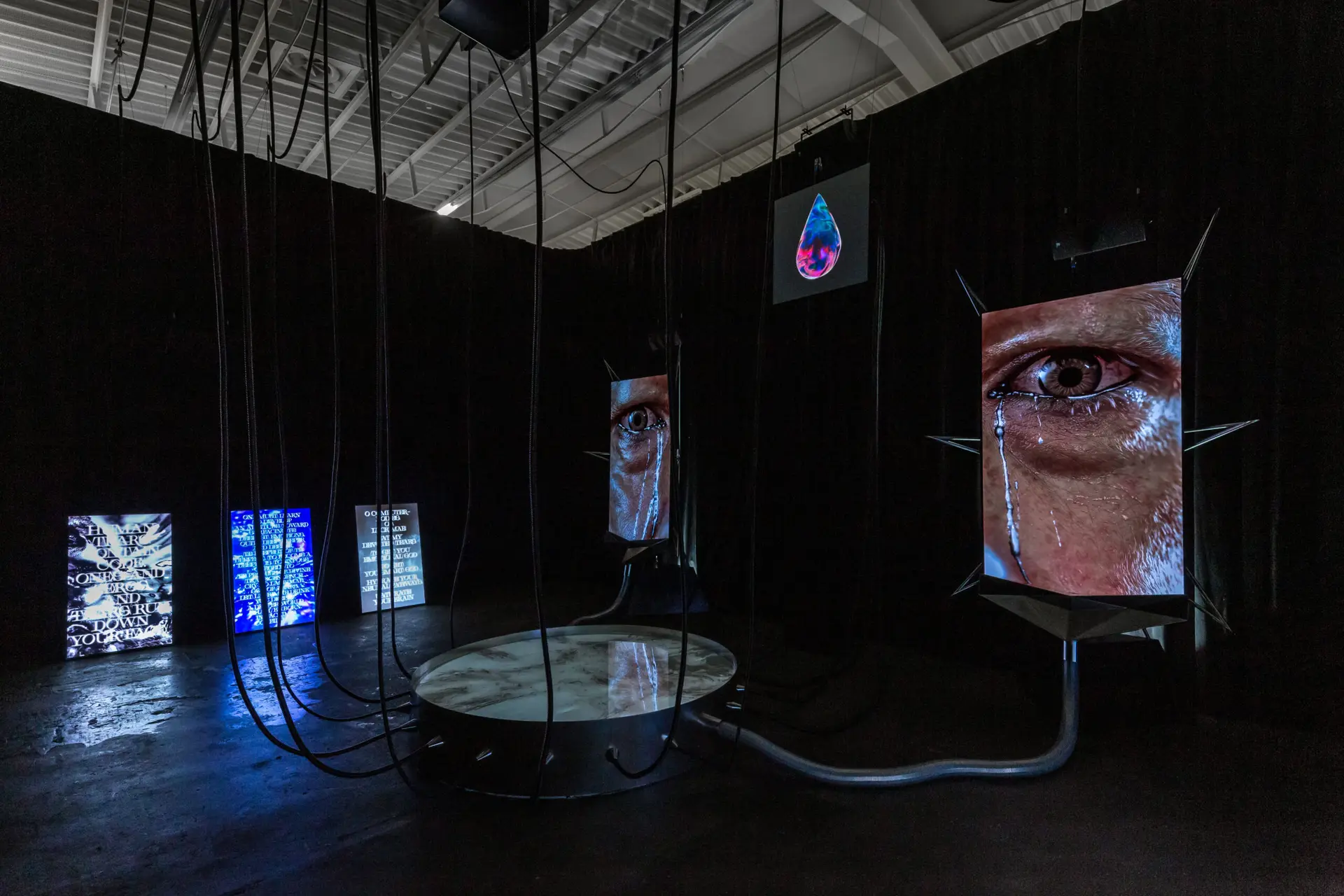
I wanted to make work that somehow goes inside these stories and fantasies (rather than take a more common position of critical distance). Because we’re living inside these stories that Silicon Valley pumps out at us. For example, modes of AI religiosity have developed in and around the tech industry, and these conditions tell us stories about religion–a rather teleologically inflected story about judgment and submission, devotion and immortality. I want to go into these stories in order to tell them differently, to show that they’re not totalized by domination, that in reality, these stories are riven with political antagonisms and resistance forces. The story is not fully written! The ending has not been determined.
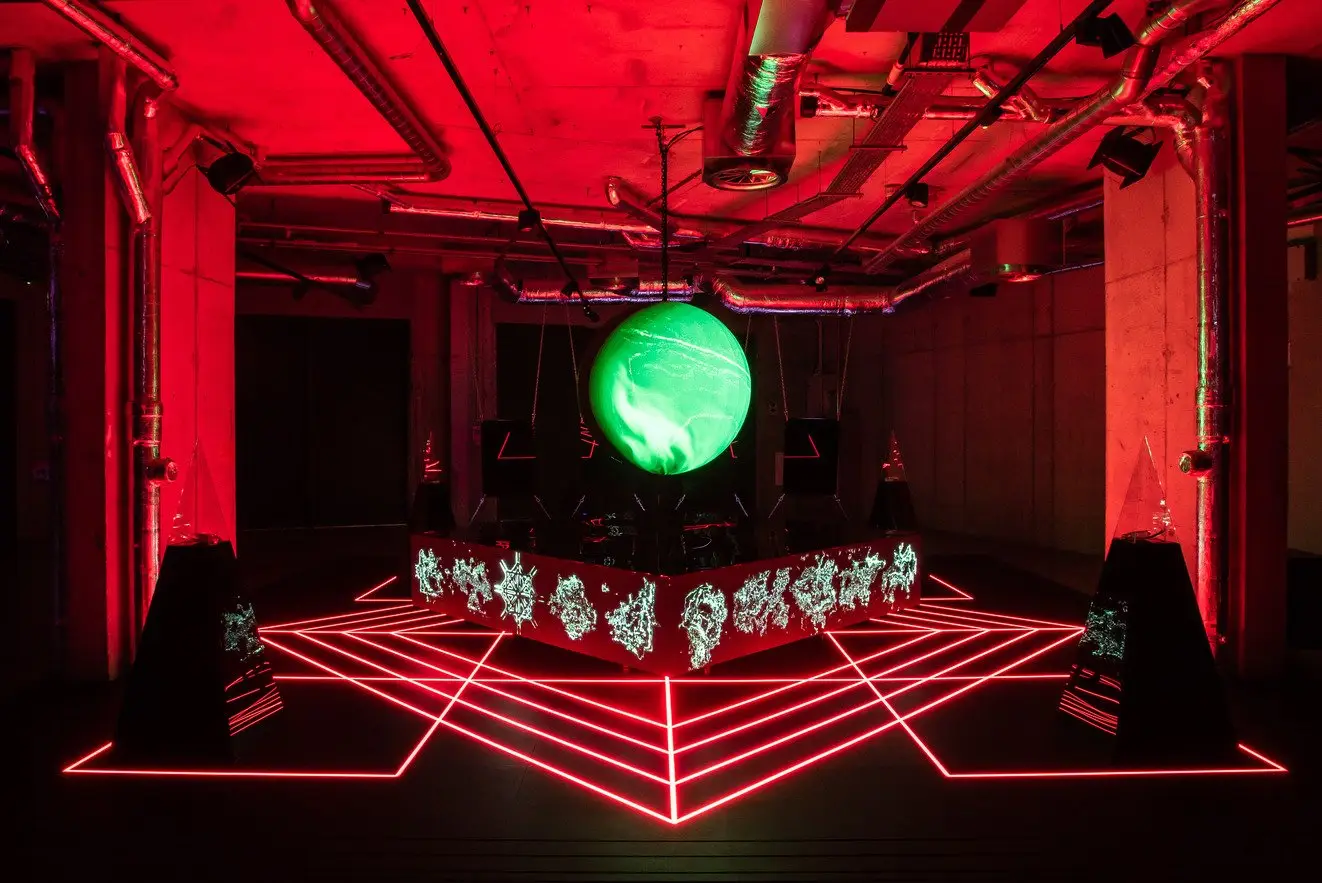
But the work also stays with the shapes of power. Understandably, we can rush to the alternative. But time is needed to study, analyze, navigate, make sense of the contours of power, in order to confront, to find weak spots. This is when the outside or the otherwise can become more in focus. My newest work CULTUS does this. It presents an understanding of religious dimensions to Silicon Valley’s power structures, but the installation also calls forth an insurrectionary heretical presence. The installation may look quite speculative and futuristic, but it’s about power and political struggle today.
—
Zach Blas’s visit to Vytautas Magnus University comes at a moment when the Lithuanian art field is increasingly grappling with the very tensions his work has been politicising for two decades. Before arriving in Kaunas, the artist also visited the Estonian Academy of Arts (EKA) in Tallinn, further strengthening his engagement with the Baltic academic and artistic landscape. The student seminars and the public lecture on May 21 are an opportunity to see how theory and artistic practice – formed in response to a specific contemporary techno-social context – can not only diagnose the present but also let us think about it differently.