

Transformation Labs' Platform
Co-creative space for students, researchers and regional stakeholders
About
Welcome to the shared virtual space of the Transform4Europe project’s Transformation Labs!
T-Labs are one of the main tools of the project, which aims to stimulate and support collaborative research work between partners, as well as to support the educational process within the Alliance.
T-Labs provide opportunities for initiating research and educational collaborations focused on the three priority areas of the Transform4Europe alliance partnership:
- Environmental transformation
- Digital transformation
- Social and economic transformation.
Through T-labs:
- We seek and find opportunities to create and use virtual collaborative spaces
- We create conditions for sharing infrastructure, resources, and knowledge
- We organize educational and research events
- We create partnerships—within the alliance and beyond
- We conduct joint research
- We provide the educational process with information and methodological resources
- … and much more.
T4EU Transformation Labs (T-Labs) enhance societal outreach and foster cooperation with the local communities. Our deep care for innovation and knowledge entrepreneurialism is reflected in this Innovative Transformation Ecosystem Platform. The T4EU Labs ecosystem combines digital, virtual and physical components (Phygital) aimed at creating content, generating research ideas and engaging in collaborative research projects within a common research space in the focus areas of T4EU.
The platform is open to all partners and external stakeholders, serving as an access point and providing an interactive ‘road map guide’ for researchers and students. All that makes the purposes of joint research generation, co-creation of ideas, external funding, and transformation-related content easier and at hand.
T-Labs
T-Labs that serve as an open collaborative space for stimulating collaboration in research and innovation are the unique tool within the T4EU alliance that brings together academia, students, stakeholders & businesses, and other partners to foster research, teaching, student mobility, and cooperation between universities. They provide a platform for sharing information within key thematic research areas and offer opportunities for sharing resources, initiating research collaborations, and establishing links between the alliance and stakeholders. As part of their activities, the individual labs organize and carry out various activities and innovative formats bringing the community together, e.g. specialized skills training in a series of Bootcamps, yearly T-lab Fair, Stakeholder challenges, etc.
The established T-Labs are used as learning-by-doing tools. In this way, the T4EU alliance can bridge the gap between research processes and lectures and help students acquire the necessary practical and conceptual skills. The T-Labs are central hubs for networking, research and teaching facilities and activities of the consortium members.
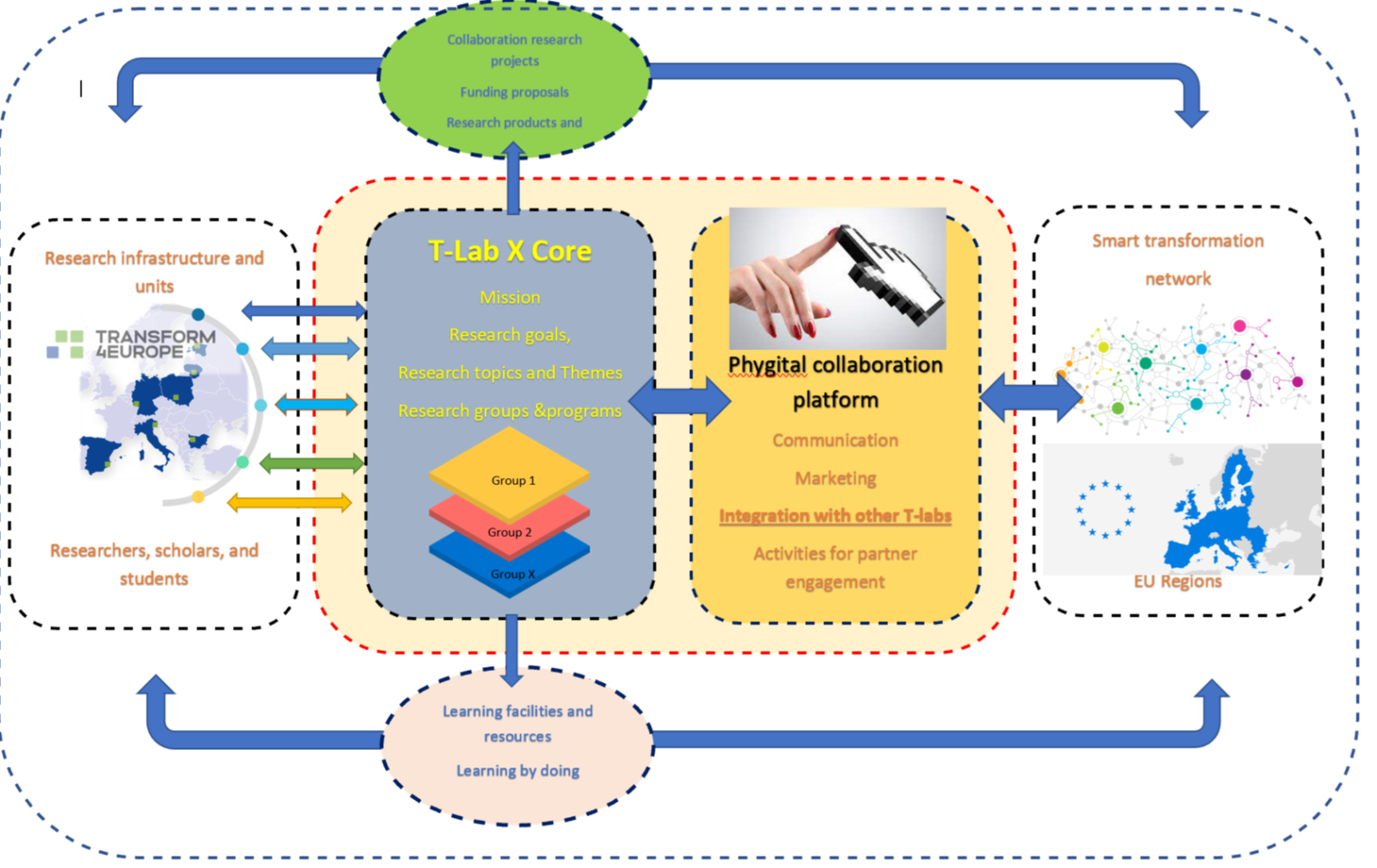
Within the Labs, the partners are sharing their human and physical resources for generations of ideas, innovations, and scientific research within the scope and the mission of T4EU project. They are also serving as diffusion hubs for sharing knowledge, innovations, technological tools, and research results not only between the involved partners and stakeholders, but with the regions and their political, business and societal subsystems.
T-Labs Road Map
The T4EU T-Labs Roadmap guide lay the foundations for the organisational, administrative and communication activities for the full operation of the established T-Labs within the current phase of the T4EU initiative and beyond. This Roadmap is an open document and will be updated in line with the evolution of the T-labs as part of T4EU infrastructure.
AIMS OF THE T-LABS ROADMAP
Through this roadmap, we aim to:
- Create the necessary organizational, administrative and communicational conditions for the full functioning of the established T-Labs within the current phase of the T4EU initiative and beyond.
- Create the prerequisites and conditions, as well as anticipate the necessary actions to make the established T-Labs and their initiatives more visible, both within the alliance and to its expanding Smart Transformation Network.
- Promote T-Labs as key initiatives to strengthen and implement the alliance’s knowledge-based entrepreneurial approach.
- Create an adequate framework to channel efforts for the sustainable development and consolidation of the T-Labs as key platforms for collaboration, research and generation of knowledge-based entrepreneurship.
WHAT ARE WE GOING TO DO? HOW WILL WE WORK TO DELIVER OUR KNOWLEDGE ENTREPRENEURS’ AMBITIONS?
The T-Labs established within the Alliance focus on two main strategic areas of key importance for its development:
- Transformational processes that profoundly affect our contemporary society and regions.
- The development and promotion of a new category of entrepreneurs who generate and implement their knowledge-based ideas, including those aimed at solving the challenges arising because of the transformation processes of regions, their environment and society.
In this respect, the ambition of the T-Labs is focused on the following important pathways:
The main aim of this pathway is to:
- Establish a common strategic development board for the three T-Labs within the alliance to formulate a common coordination, organizational and strategic framework for their development as well as to guarantee the development of the activities beyond the project cycle. The board will consist of all T-Lab Leaders (SU, USAAR & UP) the JGO Leader and partners who would like to be involved (one representative per institution). At the begging the board will be chaired by the representative of Sofia University “St. Kliment Ohridski”.
- Establish a common framework for planning, coordinating and implementing the activities of the three T-Labs starting from 2025. Every following year, each Lab is required to update its plan/framework for the current phase of the initiative and beyond.
T-LABS OPERATIONAL FRAMEWORK
Each T-Lab Leader has the responsibility:
- To admit new members with conditions, defined by the T-Labs strategic development board and published on the T4EU website.
- To update information on the T-Labs’platform in a timely manner.
- To set up a work plan / annual plan together with the lab members.
- To lead and monitor the implementation of the activities outlined in the annual plan / T-Lab year calendar.
Each member should contribute with:
- Popularising the T-Lab activities and events;
- Focusing and undertaking steps fostering joint initiatives, partnerships and collaborative research projects falling within the focus of the T-Labs.
- Conducting campaigns to reach out to researchers and stakeholders, including through the Connect4Research partnering tool.
- Taking advantage of the possibilities available trough the operation of the Joint Grants Office.
- Putting together joint project proposals for T4EU Seed Funding calls.
Initiating joint PhD study programmes and/or PhD Tracks relevant to the thematic scope of the respective T-Lab.
- Strengthening community building. Experts and researchers from all fields have all the tools they need to join forces with their peers and jointly achieve results that could not be achieved at the local/individual level.
- Enhancing broader and deeper collaboration between universities and their research centres as challenge-based knowledge creation teams in collaboration with regional innovation actors.
T-LAB PASSPORT
Each Lab creates its own presentation/passport, which is included in this platform.
T-LAB YEARLY CALENDAR
Each Lab establishes and share a yearly plan of its activities. These are the Bootcamps, Fair, Stakeholder challenges (see respective T4EU concepts and results) and any other initiatives – workshops, lectures etc.
Under this pathway, we will initiate actions and implement them by the T-Labs related to research capacity enhancement, and common training activities targeting young graduates and graduate students. T-Labs Bootcamps are foreseen as the main form of implementation of this pathway, they are to be organized in each of the established T-Labs for the current phase of the initiative. Other activities initiated by individual T-Labs may also be carried out under the pathway, including the initiation of joint PhD study programmes and/or PhD Tracks on the thematic scope of the T-Labs.
The Bootcamps are among main components of the T-Labs, which aim to engage and expand the involvement of young researchers and PhD students within the alliance; stimulate interdisciplinary research in the thematic areas of the consortium; create conditions for improving the research capacity and potential of the Alliance through problem-oriented training and create opportunities for various forms of collaboration with stakeholders. Each Bootcamp is conducted based on a predefined interdisciplinary theme that corresponds to the focus of the respective T-Lab, the stakeholder(s)/business engaged in the T-Lab activities and the thematic areas around which the alliance is formed.
This pathway aims to stimulate research collaborations between partners within the Alliance and to support the three T-Labs in processes related to research capitalisation and entrepreneurship. The main forms in which the T-Labs should engage are:
- Facilitating collaboration and liaising with the alliance’s Joint Grants Office.
- Active participation of the T-Labs in Matchmaking events (WP4, T4.4).
- T-Labs participating in Seed funding sessions of the alliance (WP4, T4.4), etc.
- Organizing promotional campaigns and encouraging the use of the Connect4research partnering tool by the T-Lab members.
A major form of event aimed at promoting the research capabilities of the T-Labs within the alliance is the T-Lab Fair, which each Lab should organise within the current project cycle.
T-Lab Fair is a single representative event that is organized by each of the three T-Labs – one event per year. The purpose of the event is to present and promote the activities of the different T-Labs including the results achieved in the course of the initiative. It will also attract new stakeholders through which the alliance’s stakeholder base will be broadened. The event also provides an opportunity to establish new contacts and initiate new collaborations both between the participants from the partner universities and with the stakeholders involved. Each event is organized based on a predefined theme that should fit the definition, thematic focus and activities of each of the three T-Labs.
In congruence with T4EU Global outreach strategy this pathway focuses on making the T-Labs visible outside the alliance and stimulating broader partnership in research, innovation and entrepreneurship.
One of the targets here is to broaden the alliance stakeholders’ base thus contributing to the strengthening of the Smart Transformation Network. A concrete measure for each T-Lab is to prepare or update the existing database of key stakeholders. Examples of entities to attract as stakeholders are municipalities, institutions, NGOs and businesses that are willing to participate in and actively support the T-Lab. Information on collaborations between the T-Lab and partner institutions – projects, joint activities, etc. – can also be listed and thus given wider visibility.
A key event format each of the three T-Labs should engage with is the Stakeholder Challenge. The Stakeholder Challenge consists in an Open Innovation Challenge, a way to directly connect companies with young people who are invited to offer a concrete solution for an issue presented by a company. Students have the chance to challenge themselves and provide innovative ideas for the company; they are guided through the process by a Mentor, a fundamental figure who provides guidance and training during the problem-solving phases of the challenges.
Environmental T-Lab Smart Cities and Regions
The Smart cities and regions T-Lab is assigned to the T4EU topic of environmental transformation and sustainability. The T-Lab focuses on the following topics:
- The natural and social systems forming the space and structure of cities and surrounding regions;
- Smart cities and regions: make them more adaptable and transformable to changing geography (climate change and global environmental problems, but also other transformation processes);
- Ecosystem services and nature-based solutions for the cities and regions;
- Risks (all kinds, natural, social and economic);
- Models for sustainable development – digital twins etc.
The T-Lab, initiated by Sofia University St. Kliment Ohridski also includes the alliance partners University of Trieste (Italy), University of Primorska (Koper, Slovenia), Vytautas Magnus University (Kaunas, Lithuania), University of Silesia (Katowice, Poland), University of Alicante (Spain) and Universidade Católica Portuguesa.
- University Center of Geospatial Research and Technologies
- Sofia Municipality
- Burgas Municipality
- Bulgarian Geographical Society
Here you will find all the Lab activities (past and upcoming) and other collaborations with the other work packages, and non-alliance activities directly related to the Labs
According to the project structure, the main Labs activities consist of Bootcamps, T-Lab fairs & Stakeholder challenges.
T-Lab activities carried out during the current phase of the T4EU project:
- First T4EU Bootcamp “Sustainable Development and Environmental Transformation: Effective Climate Adaptation and Innovations” 10-12 September 2024 – YouTube video: youtube.com
- T4ERI Stakeholder Assembly in Burgas 10 September 2025 (in collaboration with T4EU Smart Cities and Regions Environmental Transformation Lab)
- Communication with T4EU partners and in particular T-Lab leaders to exchange ideas and plan common activities
- Collaboration with T4EU Chair Exchange initiative – Usil Professor delivered lectures on Decolonising Climate Change and Management, plans to join the T-Lab on Climate Change and design specific joint activities
- T-Lab Fair & Second Stakeholder Challenge “Climate change and European cities: adaptation to urban heat island effect and nature-based solutions” 02-04 June 2025 – YouTube video: youtube.com
If you are interested in the activities of our T-Lab, would like to become a partner or participate as a stakeholder, please contact us: transform4europe.su.bg@gmail.com – Sofia University team.
Here you will find information on collaborations between the Lab and partners presented in variety of projects.
Coming soon
Accordion Content
T-Lab Critical Heritage
The Critical Heritage Lab opens a collaborative space and aims to bring together academia, organisations, institutions, NGOs, businesses, and other partners to foster research, teaching, student mobility, and cooperation between universities, while also engaging non-academic stakeholders. It aims to promote research in the field of critical heritage among the members of the T4EU network.
The Lab is structured into three interdisciplinary research pillars:
- Heritage studies, memory studies, public history, including museology and interpretation,
- Border studies and migration,
- With the concept of “border heritage” and “border-straddling heritage” (Mozaffari & Harvey 2023) as a transversal and overarching thread of research.
The Critical Heritage T-lab, initiated by Vytautas Magnus University, is a collaborative project between the T4EU alliance partners University of Primorska (Slovenia), Estonian Academy of Arts, University of Trieste (Italy), Vytautas Magnus University (Lithuania), Jean Monnet University Saint-Étienne (France), Sofia University St. Kliment Ohridski (Bulgaria), as well as University of Silesia (Katowice, Poland), Saarland University (Germany), University of Alicante (Spain), and Catholic University of Portugal.
The T-Lab at the University of Primorska works hand in hand with the Unesco Chair for Heritage Interpretation and Education for Enhancing Integrated Heritage Approaches at the University of Primorska and is involved with various stakeholders that the Unesco Chair and the Faculty of Humanities UP have collaborated with in the past decades. They are: Municipality of Koper, Municipality of Piran, Municipality of Izola, Municipality of Ankaran, Municipality of Kozina, Municipality of Divača, Municipality of Nova Gorica, Regional Museum Koper, Maritime Museum Piran, Izolana Izola, Mythical Park Rodik, Archaeological Park San Simon, Regional Archive Koper, Archaeological Society of Slovenia, PINA, Interpret Europe.
Information on collaborations between the T-Lab and partners:
- https://fhs.upr.si/raziskovanje/institut-za-arheologijo-in-dediscino/
- https://fhs.upr.si/en/research/institute-for-archaeology-and-heritage/#pll_switcher
- https://fhs.upr.si/raziskovanje/unesco-katedra/
- https://fhs.upr.si/en/research/unesco-chair/
- https://fhs.upr.si/raziskovanje/institut-za-medkulturne-studije/
- https://fhs.upr.si/en/research/institute-for-intercultural-studies/
Here you will find all the Lab activities (past and upcoming) and other collaborations with the other work packages, and non-alliance activities directly related to the Labs
According to the project structure, the main Labs activities consist of Bootcamps, T-Lab fairs & Stakeholder challenges. Here you will find the annual calendar of Lab events:
Coming soon in 2026 T-Lab Critical Heritage Bootcamp and T-Lab Fair.
Additional activities:
2024
- Interpret Europe conference – March 2024, an international conference on heritage interpretation
- International Summer School of Museology and Heritage, Koper, September 2024
- In the gardens of (In)visible – exhibition and project, March 2024, movable exhibition was also presented in Trieste, Geneva, Divača, etc.
Publications:
- Katja Hrobat Virloget: https://fhs.upr.si/etnografija-tisine-znanstveni-clanki/
- ČEBRON LIPOVEC, Neža. Integrating participatory approaches in the procedures of built heritage conservation, the case of Slovenia. V: ISAAC-MENARD, Rachel (ur.). Urban futures – cultural pasts : sustainable cities, cultures & crafts : Universitat Politècnica de Catalunya, AMPS, 15-17 July, 2024. Vol. 3, Heritage, culture & place. [S. l.]: AMPS, 2024. Str. 406-413. AMPS proceedings series, 40.3. ISSN 2398-9467. https://amps-research.com/wp-content/uploads/2025/03/Amps-Proceedings-Series_40.3.pdf. [COBISS.SI-ID 229050883]
- LAMPIČ, Barbara, REBERNIK, Lea, ČEBRON LIPOVEC, Neža, NOVAK KLEMENČIČ, Renata. Monitoring the condition and endangerment of cultural heritage in Slovenia for efficient management and adaptive reuse. V: ŠEĆEROV, Velimir (ur.). Quo vadis geographia? : u susret novim geografskim horizontima : zbornik radova i zbornik mladih istraživača. Knj. 2. Beograd: Univerzitet u Beogradu, Geografski fakultet: Srpsko geografsko društvo, 2024. Str. 290-298, ilustr., zvd. ISBN 978-86-6283-155-2. DOI: 10.5937/KonGef24091L. [COBISS.SI-ID 206163715]
- MAVRIČ, Tim, ČEBRON LIPOVEC, Neža. Social media groups in interaction with contested urban narratives : the case of Koper/Capodistria, Slovenia. Urban planning. 2024, vol. 9, [article no.] 7083, str. 1-18, tabele. ISSN 2183-7635. https://www.cogitatiopress.com/urbanplanning/article/view/7083, DOI: 10.17645/up.7083. [COBISS.SI-ID 177116931]
2025
- Co-organisation of the BIP Living Trees as Architecture (main organizer VMU Lithuania), within the International T4EU Week in St. Etienne; and participation at the Students: https://sites.units.it/transform4europe/index.php/2025/03/07/t4eu-week-2024-exploring-design-in-all-its-forms-at-jean-monnet-university-in-st-etienne/
- International Summer School of Museology and Heritage, Koper, September 2024 and 2025, Research and Practices in the rapidly Changing World: https://fhs.upr.si/international-summer-school-of-museology-and-heritage/
- Collaboration at the Summer School of Heritage, Sofia University, September 2025
- Matchmaking event, 4th – 5th September2025: https://transform4europe.eu/networking-of-the-young-generation-of-researchers-at-the-university-of-primorska/
- 4th September 2025 – Science Café, Critical Heritage: https://transform4europe.eu/science-cafe-on-critical-heritage/
- 25th September 2025 – International Event – Railway Station Nova Gorica – Multivocality of Heritage: https://fhs.upr.si/zelezniska-postaja-nova-gorica-vecglasnost-dediscine-stazione-ferroviaria-multivocalita-del-patrimonio-culturale/
Exhibition:
- 20.10. to 14.11.2025 – Hosting an exhibition Yugoslav Collaboration in UNESCO International campaign to save the monuments in Nubia (1963 – 1964)
Guest lectures:
- 10 June 2025 – Dr. Kathrin Pabst, My Nazi Grandfather and Displaced Family: Uncovering Family Secrets, Silenced Memory, and the Shadows of History.
- 28th October 2025 – Prof. Abdelrazek Elnaggar, The UNESCO Campaign to Save the Nubian Monuments in Egypt: Moving the Immovable
- 12th November 2025 – Prof Jan Ciglenečki, Results of the Yugoslav and Slovenian Campaign in Egypt
Here you will find information on collaborations between the Lab and partners presented in variety of projects.
If you are interested in the activities of our T-Lab, would like to become a partner or participate as a stakeholder, please contact us: irena.lazar@fhs.upr.si; nezacl@fhs.upr.si.
The Entrepreneurship Transformation Lab
The Entrepreneurship Transformation Lab (T‑Lab) at Saarland University is the institutional anchor of the Transform4Europe (T4EU) Alliance’s „Entrepreneurship” thematic line. The Lab fosters entrepreneurial mindsets focused on societal and knowledge‑based transformation. It links interdisciplinary academic innovation with regional socio-economic ecosystems through co‑creative, challenge‑based formats. Saarland University (https://www.uni-saarland.de/en/home.html), coordinated under its central entrepreneurship centre Triathlon (https://www.uds-triathlon.de/), embeds the T‑Lab in a broad startup and transfer ecosystem within the T4EU framework.
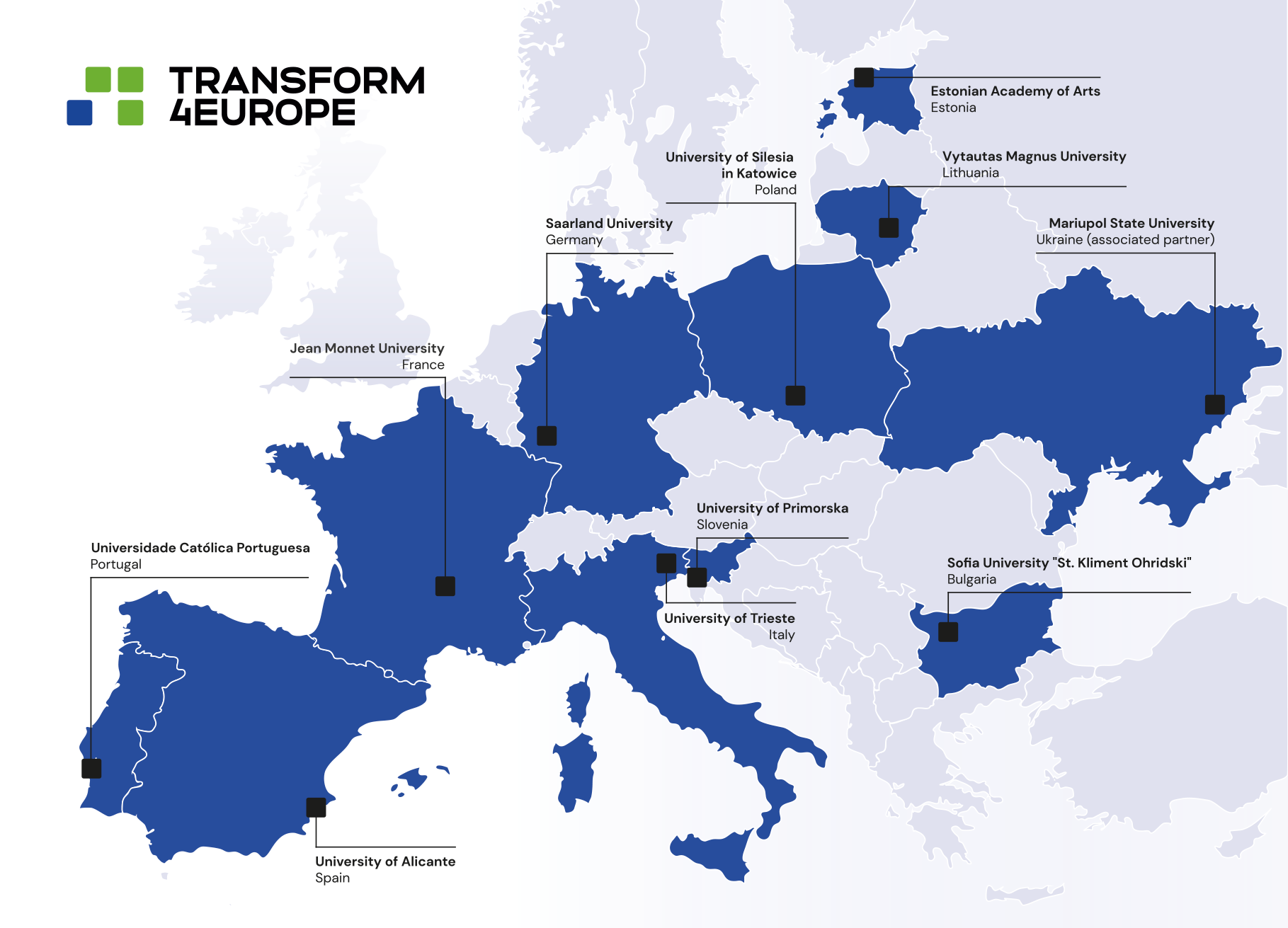
The T4EU Alliance unites 11 European universities across Spain, Portugal, Estonia, Poland, Bulgaria, Italy, Lithuania, France, Slovenia, Ukraine, and Germany. Saarland University, as host of the Entrepreneurship T‑Lab, collaborates with all partner institutions, as well as regional partners from the private sector – startups and corporates.
The T‑Lab leader at Saarland University compiles an active stakeholder network, including:
- Saarland and the Saarbrücken region, which support the Lab as local partners, co‑hosting events, participating in challenges, and engaging in joint regional innovation efforts.
- Regional innovation councils, industry partners, incubators, and regional startup networks – many of which are integrated via the Triathlon entrepreneurship ecosystem.
- Academic and policy actors across partner regions, engaged through shared research, teaching, and co‑creation initiatives under T4EU’s Work Package 4 (regional ecosystem cooperation).
Where possible, the Lab works directly with various partners in joint activities – e.g. local entrepreneurship bootcamps, hackathons, and transfer projects supported by the university and its partners.
The Lab’s hands‑on programs include:
- An entrepreneurial Bootcamp and several Stakeholder Challenges, co‑designed with partners from the private sector, as well as T4EU partners, to stimulate real‑world innovation around regional and further reaching needs
- T‑Lab fairs, where T4EU partners, students, startups, regional stakeholders, and partner institutions present collaborative transformation initiatives.
- T4EU Science Café’s, which foster exchange among interested parties in a relaxed environment.
- Other non‑alliance activities carried out in the framework of Triathlon: technology transfer events, startup mentoring, patent and innovation workshops, and regional engagement sessions. Saarland University has been recognized as one of Europe’s top entrepreneurial universities in the Triple E Awards.
Coming soon in 2026:
- T4EU T-Lab Bootcamp & Fair, Saarland University, 27–30 April 2026
Recognition: In 2023 Saarland University ranked third in Europe in the “Entrepreneurial
University of the Year” category at the Triple E Awards, reflecting its strong transfer and entrepreneurial ecosystem.
- Recognition: Saarland University has once again achieved second place among large universities in the latest Start-up Radar published by the Stifterverband für die Deutsche Wissenschaft (Donors’ Association for the Promotion of Sciences and Humanities in Germany). This confirms its position as one of the leading start-up universities in the state. (https://www.uni-saarland.de/en/news/universitaet-des-saarlandes-verteidigtspitzenplatz-im-gruendungsradar-des-stifterverbandes-36307.html)
- The Federal Ministry for Economic Affairs and Energy has awarded the consortium “Southwest X – The Bridge to Innovation”, led by Saarland University, together with its partner institutions, in the nationwide EXIST flagship competition “Startup Factories”. The concept of the future Startup Factory (original application title “The Bridge”) aims to significantly increase the number of startups in the region and make a significant contribution to transformation. (https://www.uds-triathlon.de/news/erfolg-im-startupfactory-wettbewerb/)
- Central Infrastructure: The university’s Triathlon centre bundles all entrepreneurship, innovation, and transfer support under one roof—serving as the operational backbone for the T‑Lab’s regional engagement and startup support.
Here you will find information on collaborations between the Lab and partners presented in variety of projects.
Core projects directly associated with the Entrepreneurship T‑Lab:
- Annual Strategic Assembly open to staff, researchers and students across T4EU, facilitating exchange of best practices and dialogue across academia, industry, and governance in different topics.
- Regional transfer and startup initiatives driven by Triathlon, co‑funded via T4EU Seed Funding or Internationalisation Funds, linking Saarland University innovation projects with partner municipalities and ecosystem actors.
If you are interested in joining or collaborating with the Entrepreneurship Transformation Lab reach out to us.
Saarland University – Transform 4 Europe Lab Lead
Email: andre.siegl@uni‑saarland.de
We welcome participation from students, researchers, municipal stakeholders, ecosystem partners, and anyone committed to knowledge‑entrepreneurial transformation.