T4EU presidency

T4EU aims to further develop its joint governance structure by implementing a rotating presidency, nominating a Secretary General

About the T4EU presidency

Based on the work-plan of the Transform4Europe alliance’s proposal for the 2nd round of financing from the European Universities program, the rotating presidency has been implemented.

Rotating presidency will function on a yearly basis, with a new partner taking on the presidency from November 1st until October 31st of the following year, each former president becoming vice-president in the next year.

T4EU aims to develop its joint governance structure by implementing a rotating presidency, nominating a Secretary General as a critical figure for the T4EU Alliance, and creating a joint T4EU legal entity.

Sven Idarand
Sven Idarand
Secretary General
Photo by Małgorzata Dymowska

The Secretary General will support the rotating presidency and, through their involvement, guarantee the continuity of the strategic framework of the whole alliance. The Secretary General and the holder of the presidency will divide the representation duties of the T4EU alliance in its relations with institutions of the EU.

The role of the presidency is neutral and mediating; it should work to facilitate commitments and agreements between the partners and nurture discussions between different management structures of T4EU. The main goal of the presidency is to foster the best work and decision-making between all the partners.

Consortium management structure

  • Executive Board
  • President and Vice-President
  • Steering Committee
  • Strategic Assembly
  • Student Council
  • Joint Offices
  • Secretary General

T4EU Presidency

Current Presidency

logo

About Sofia University Saint Kliment Ohridski

Sofia University St. Kliment Ohridski is the first institution of higher education in Bulgaria, founded in 1888 as a continuation of the nation’s centuries-long cultural and educational traditions. Over time, our institution developed into one of the most respected centres of science and scholarship on the Balkans.

Today, Sofia University St. Kliment Ohridski is the largest and most prestigious academic institution in Bulgaria. It comprises 16 faculties and offers education in 119 degree programmes across a wide range of disciplines. Our University has a strong and growing research profile, with a mission to advance Bulgaria’s scientific, educational, and cultural potential while generating new models of social development, institutional change, and socially relevant research.

Internationalisation is a core pillar of our strategy. We maintain inter-university agreements with more than 80 universities worldwide, participate in hundreds of international and European projects, and engage in extensive multilateral cooperation with scholars from across the globe. We are the national leader in student and academic staff mobility, actively contributing to the European Higher Education Area and the promotion of European values in university education.

Vision for the Alliance: Exploring the Implications of AI in higher education and research

For more than a century, Sofia University has shaped generations of scholars, researchers, and civic leaders. Today the university is a living bridge between academic tradition and forward-looking innovation, combining profound scholarly expertise with the tools of digital transformation.

In October 2025, we embarked on a year dedicated to advancing artificial intelligence in higher education and research, a journey of shared discovery across our T4EU European Alliance. Joining Transform4Europe strengthens our ability to internationalise research and education, exchange good practises, and build interdisciplinary teams that address the pressing challenges of our time.

Our presidency stands on three guiding principles:

  • enhanced collaboration and exchange of good practises across partners, 
  • stronger synergies among the Alliance’s T-Labs, 
  • a clear focus on innovation that links research, teaching, and societal impact. 


We do not see this year as mere coordination, but as a proactive opportunity to shape how universities embrace AI responsibly and creatively.

The central theme of our mandate is artificial intelligence in higher education and research, with a particular focus on educational processes and the formation of interdisciplinary academic teams. We examine AI-driven pedagogical and research innovation alongside questions of ethics, institutional readiness, and human-centred governance.

Activities

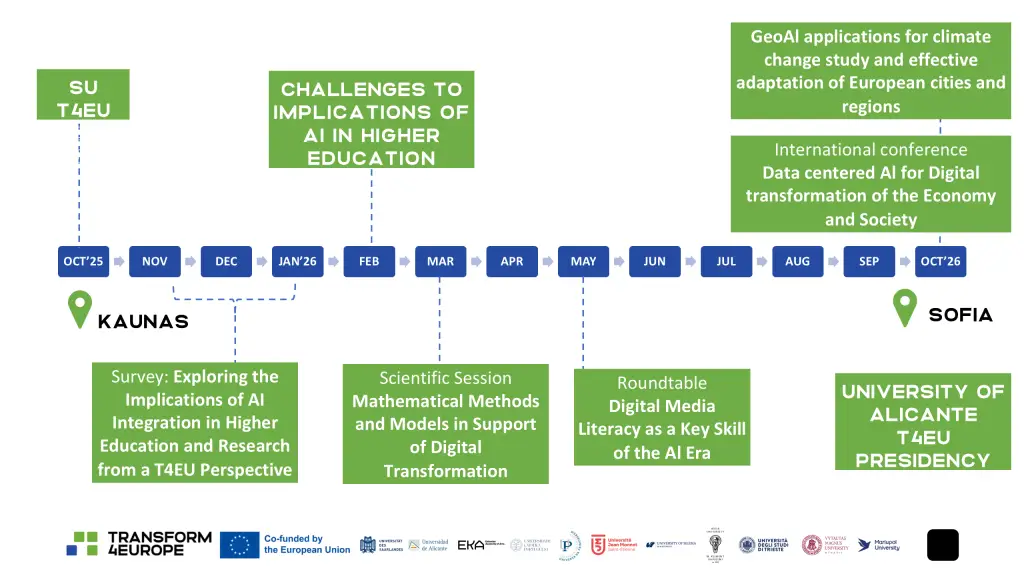
Exploring the Implications of AI Integration in Higher Education and Research from a T4EU Perspective

Our first activity, an online study, will map the implications of AI integration in higher education and research from the Transform4Europe perspective. The survey will gather comparative data on current practises, identify gaps and opportunities, and offer a baseline for shared institutional policies and training. 

Challenges to the implications of AI in higher education

In February we will turn to concrete challenge cases, real scenarios where AI intersects with teaching, assessment, research ethics, and professional roles. We will investigate the potential benefits of AI in education against the potential drawbacks, offering responses to the main concerns we hear from academics, students or partners regarding AI’s impact on the professional development and role.

The challenges are developed as specific case studies to which a response is needed and aim at:

  • weighing the potential benefits of AI in education against the potential drawbacks;
  • offering responses to the main concerns we hear from academics, students or partners regarding AI’s impact on their professional development and role;
  • identifying what kind of support and training is essential to ensure academics are adequately prepared to integrate AI ethically and effectively;
  • identifying whether there are already policies and applied practices in the partner higher education institutions;
  • identifying how ethical risks associated with AI in education for partner organisations are ranked.


They will offer real practice cases for collaborative problem-solving and will result in the creation of a portfolio of well-defined “challenge cases” on AI use in education. Their solution and exchange among partners will strengthen alignment between research, teaching, and institutional strategies. The final outcomes will be presented at the General Assembly in Sofia 2026.

Specialized section “Mathematical Methods and Models in Support of Digital Transformation”, 29 March 2026

The year 2026 will be dedicated to bringing research closer to people and making knowledge accessible across disciplines. In March 2026, we start with a specialised academic event organised by the Faculty of Mathematics and Informatics as part of their traditional Spring Scientific Session.

A second event is an international conference called Data Centre AI for the Digital Transformation of the Economy and Society. The conference will serve as a forum for discussing interdisciplinary research and collaboration, focussing on how data-driven AI models and technologies are transforming various sectors, including education, healthcare, media, finance, etc. Attendees will have the opportunity to discuss policies and present their innovation research and practical innovation. 

Roundtable discussion on Digital Media Literacy as a Key Skill of the AI Era, second half of May

In May, our roundtable will address digital media literacy as a key skill in the AI era. Dedicated to digital skills, digital literacy and the use of AI by teachers in education, higher education and secondary education.

GeoAI applications for climate change study and effective adaptation of European cities and regions, 27-28 October 2026

In October we hold a combined webinar and hands-on workshop on Geospatial Artificial Intelligence (GeoAI) applications for climate change study and effective adaptation of European cities and regions. This is a hybrid event exploring how geospatial AI can help us to predict, analyse and manage the growing climate challenges around us and to cope with the fast-changing geography which is resulting from that. Experience the best of both worlds, an interactive online webinar and hands-on workshop where experts and participants come together to share ideas, tackle real-world cases and co-create solutions for a more resilient future. Students and young researchers with little or no programing skills will get the chance to discover how GeoAI is changing the way we see our planet.

International conference on “Data Centred AI for the Digital Transformation of the Economy and Society: Artificial Intelligence – freedom or constraint”, 27-28 October 2026

Our concluding event will be the International Conference Data-Centred AI for the Digital Transformation of the Economy and Society, Artificial Intelligence, Freedom or Constraint.

What a spectacular way to conclude a year of collaboration, research and innovation and to pass the presidency on to the University of Alicante!


A timeline with events and milestones for the Transform4Europe initiative, highlighting AI, digital transformation, and climate adaptation in higher education, with key events in Kaunas and Sofia from October to October.

A Message from the Rector

“The Sofia University presidency aims to strengthen the Alliance’s research capacity, to equip staff and students with new skills and to create practical resources for ethical AI use in education. By combining research, training and public debate, we seek measurable improvements in teaching practise, institutional policy and cross-border cooperation. 

Together for Transformation, Sofia University leads a human-centred approach to artificial intelligence in European higher education.

Together for Transformation, following our mission to become one integrated European university based on shared European values, a diverse and inclusive Alliance deeply rooted in the respective regional ecosystems, educating and training knowledge entrepreneurs as drivers of transformation for the benefit of sustainable and resilient European societies.

Thank you for joining us on this journey.”

Prof. Georgi Valchev,  
Rector of Sofia University St. Kliment Ohridski

team

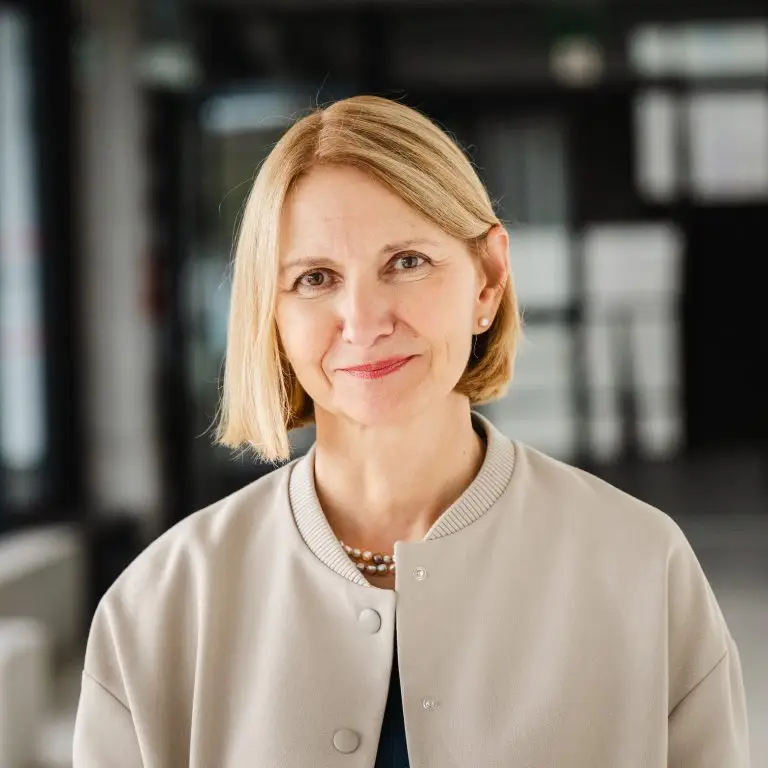
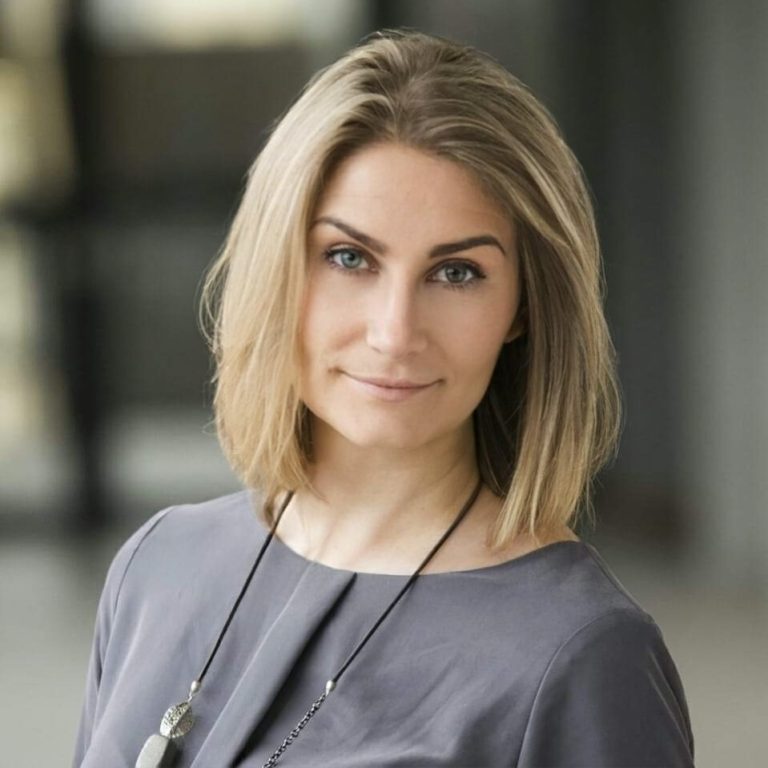
A middle-aged woman with blonde hair in a bob cut, wearing a light beige jacket, a dark top, and a pearl necklace, smiles slightly while standing indoors, embodying the spirit to Transform for Europe against a blurred background.

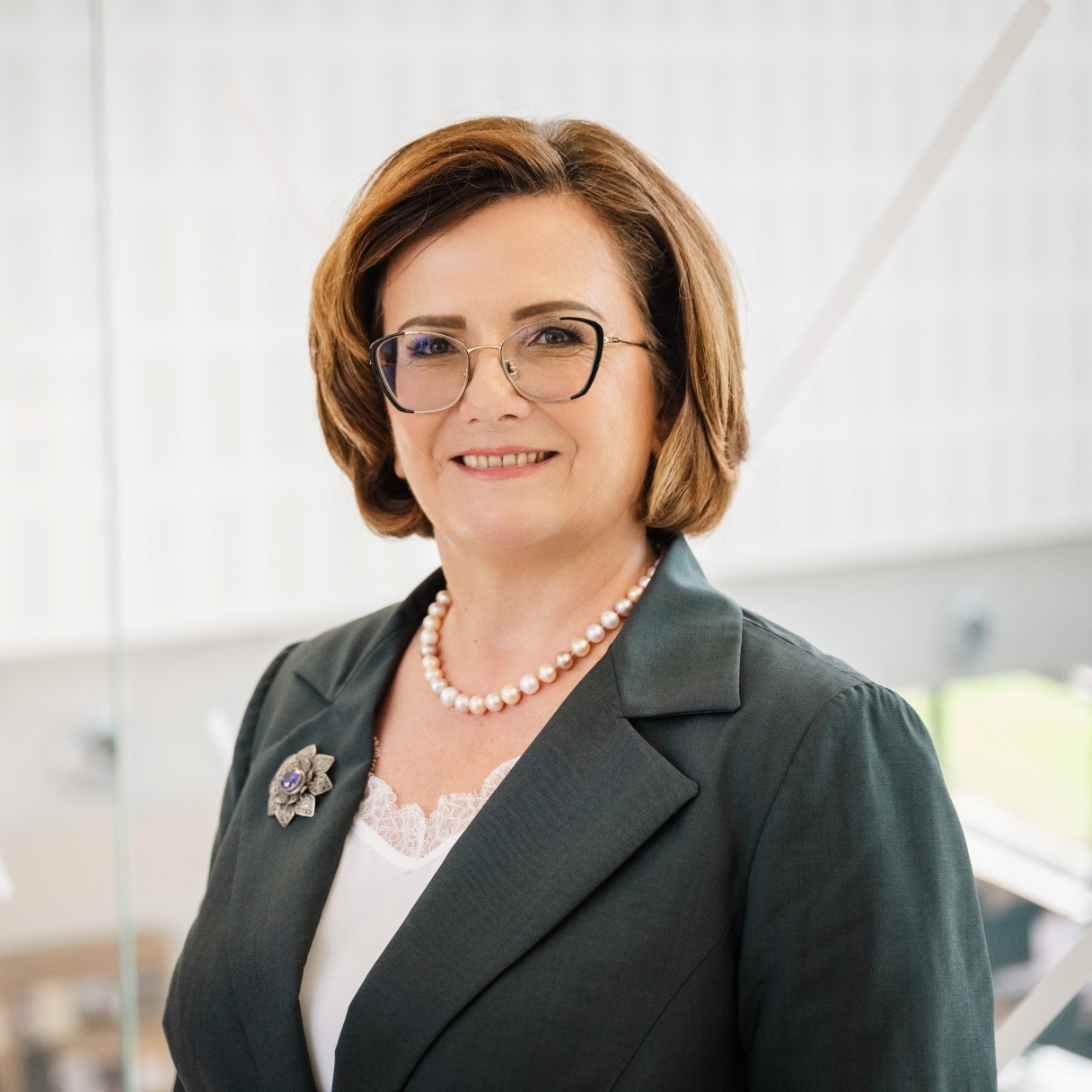
Ineta Dabašinskienė

Rector of the Vytautas Magnus University, President of the T4EU Presidency

Photo: Vytautas Magnus University

Rolandas Urbonas

Vice-Rector for Research

Photo: Vytautas Magnus University

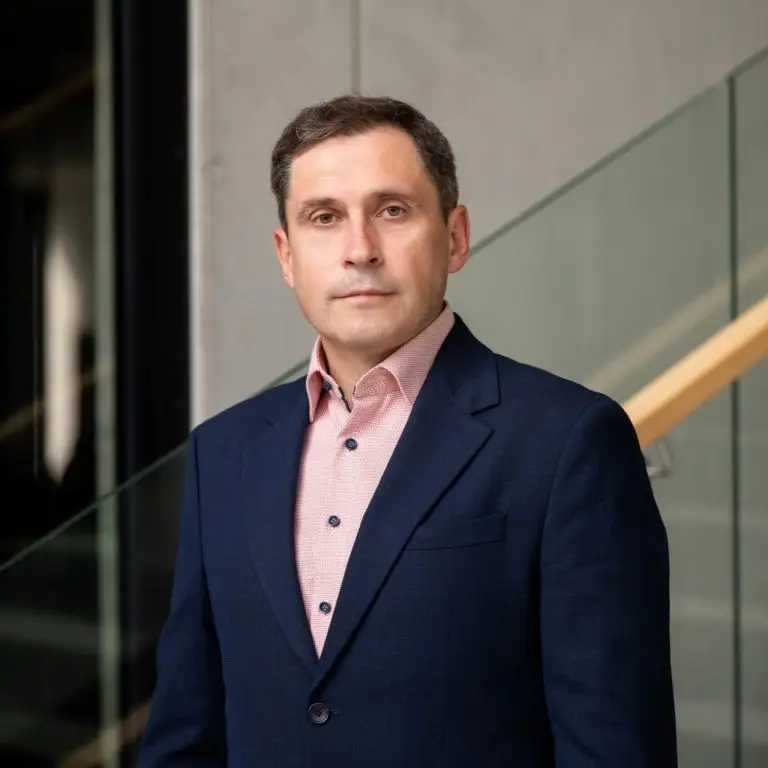
A man in a navy suit and light pink shirt stands indoors before a modern glass and wood staircase, looking directly at the camera with a neutral expression—poised to transform for Europe’s dynamic future.

Rytis Pakrosnis

Vice-Rector for Studies, T4EU Institutional Coordinator

Photo: Vytautas Magnus University

Astrida Miceikienė

Vice-Rector for Strategic Development and Finance

Photo: Vytautas Magnus University

Vilma Bijeikienė

Vilma Bijeikienė

Vice-Rector for Communication

Photo: Vytautas Magnus University

Tomas Mickevičius

Tomas Mickevičius

Project Manager

Photo by Indre Baltakyte

Kateryna Horiunova

Kateryna Horiunova

Project Coordinator

Photo by Jonas Petronis

Rasa Simanavičienė

Rasa Simanavičienė

Project Administrator

Photo by Jonas Petronis

Ina Žurkuvienė

Ina Žurkuvienė

Head of Communication for the T4EU Alliance

Photo: Vytautas Magnus University

Rotating presidency

Presidency
Vice-president
UP to 2023
logo
2023-2024
logo
logo
2024-2025
logo
logo
2025-2026
logo
logo
2026-2027
logo
logo

Up to 2023

Saarland University logo

Presidency

News

Archive

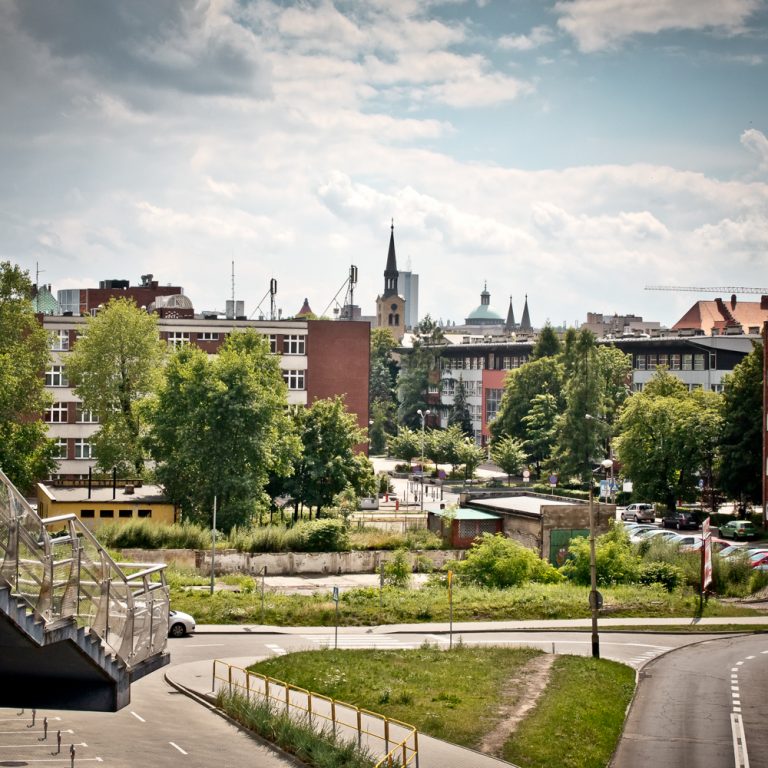
A view of a city with a bridge in the foreground

T4EU presidency 2023–2024

University of Silesia in Katowice

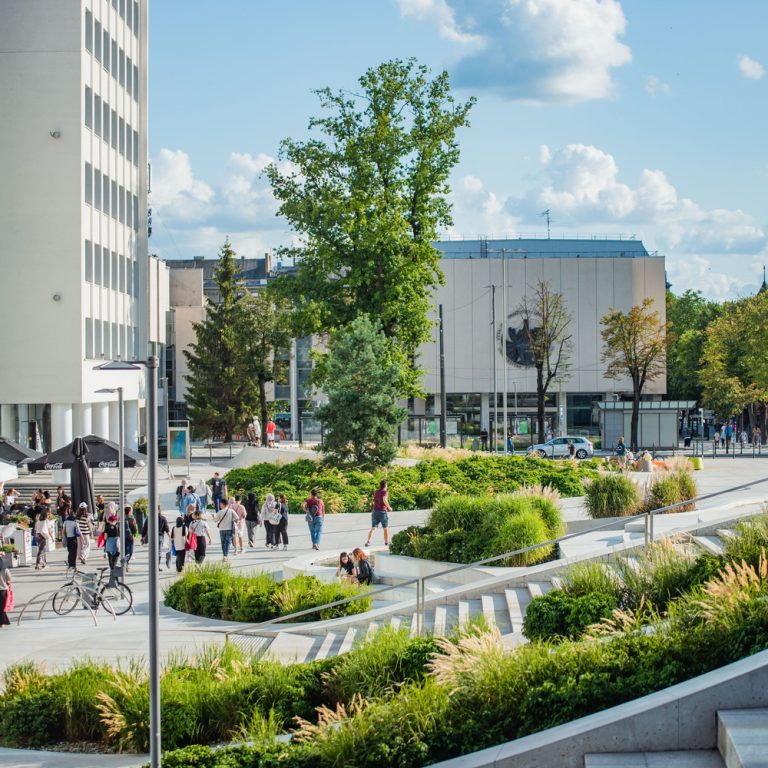
T4EU presidency 2024–2025

Vytautas Magnus University

Four rounded white squares are arranged in a grid pattern on a light gray background, with space separating each square.